 Read Aloud
OBBBA EXCERPT—PUBLIC LAW 119–21—JULY 4, 2025 139 STAT. 75




Please join me in recognizing President Donald J. Trump as the 2027 winner of the Annual Bruessard Award. He is being recognized because his Trump Accounts program reflects another one of his praiseworthy initiatives. Being the consummate hype-meister (or the master of hyperbole) that he is, President Donald Trump knows how to command the attention of the popular media. I am certain that he would deem the Trump Accounts program as the best savings program the likes of which nobody has ever witnessed before it. While wielding the world's biggest megaphone as President of the United States, President Donald Trump also knows precisely how to galvanize the popular media's attention to cover the Trump Accounts program. He has brilliantly succeeded in bringing widespread public attention to the Trump Accounts program. President Donald Trump deserves special praise for not only popularizing the Trump Accounts program but also for making it a reality by providing the funding to kickstart the Trump Accounts process. It is conceivable that the Trump Accounts program very well might turn out to be President Donald Trump's most consequential and most enduring positive legacy. When the children of today (as of 2026) begin to liquidate their Trump Accounts balances, say, 18, 28, 55, or 65 years into the future, then surely it will give them fond memories of President Donald Trump as the one who made it happen. 👍 👏 🙏 🙇
SPECIAL NOTE: To coincide both with the USA celebrating its 250 years of independence on 04-July-2026 and, also, with 04-July-2026 being the official opening date for the Trump Accounts, this 2027 winner page is being released on 01-May-2026 or eight months in advance of its originally planned 01-January-2027 release date. 04-July-2026 is huge (in the USA)! It's exciting! It's a celebration! It's all good! 🎈 🎉 🥳 🇺🇸
At the outset, the reader should know that I am not a supporter of President Donald Trump, the politician, in the sense that I did not vote for him. To be sure, I quite possibly am one of President Donald Trump's harshest critics. At the same time, it has to be acknowledged that he has made some praiseworthy accomplishments during his two terms as President of the USA—and some not so praiseworthy accomplishments, too.
His praiseworthy accomplishments include these:
His not so praiseworthy accomplishments include these:
This 2027 winner page is not about criticizing President Donald Trump. Instead, it is all about praising and celebrating President Donald Trump for getting the Trump Accounts program off the ground and across the finish line, so to speak—and he got it done in time to dovetail with the United States of America's 250th birthday celebration on 04-July-2026. What a birthday gift 🎁 🎂 🌭 🍕 ‼


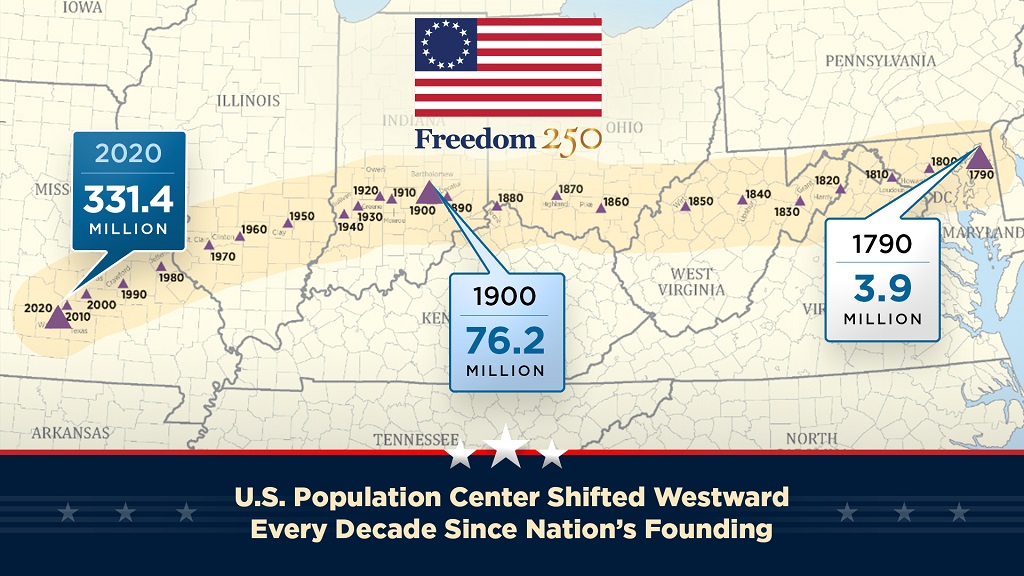

| United States | Population | Percent Growth | Number Growth | Website1 | Website2 |
|---|---|---|---|---|---|
| 1900 Census | 76,212,168 | Website1 | Website2 | ||
| 1910 Census | 92,228,531 | 21.02% | 16,016,363 | Website1 | Website2 |
| 1920 Census | 106,021,568 | 14.96% | 13,793,037 | Website1 | Website2 |
| 1930 Census | 123,202,660 | 16.21% | 17,181,092 | Website1 | Website2 |
| 1940 Census | 132,165,129 | 7.27% | 8,962,469 | Website1 | Website2 |
| 1950 Census | 151,325,798 | 14.50% | 19,160,669 | Website1 | Website2 |
| 1960 Census | 179,323,175 | 18.50% | 27,997,377 | Website1 | Website2 |
| 1970 Census | 203,211,926 | 13.32% | 23,888,751 | Website1 | Website2 |
| 1980 Census | 226,545,805 | 11.48% | 23,333,879 | Website1 | Website2 |
| 1990 Census | 248,709,873 | 9.78% | 22,164,068 | Website1 | Website2 |
| 2000 Census | 281,421,906 | 13.15% | 32,712,033 | Website1 | Website2 |
| 2010 Census | 308,745,538 | 9.71% | 27,323,632 | Website1 | Website2 |
| 2020 Census | 331,449,281 | 7.35% | 22,703,743 | Website1 | Website2 |
The Trump Accounts program was incorporated into the so-called One, Big, Beautiful Bill Act (OBBBA) or PUBLIC LAW 119–21—JULY 4, 2025 () under Sec. 70204 titled "Trump accounts and contribution pilot program." The Trump Accounts concept is said to have been the brainchild of financier Brad Gerstner, and it was championed in Congress by Texas Senator Ted Cruz. In essence, the Trump Accounts program is an investment program. The program is meant to foster the long-term economic stability, growth, and security of its account beneficiaries at the point in time when they reach adulthood at 18 years old.
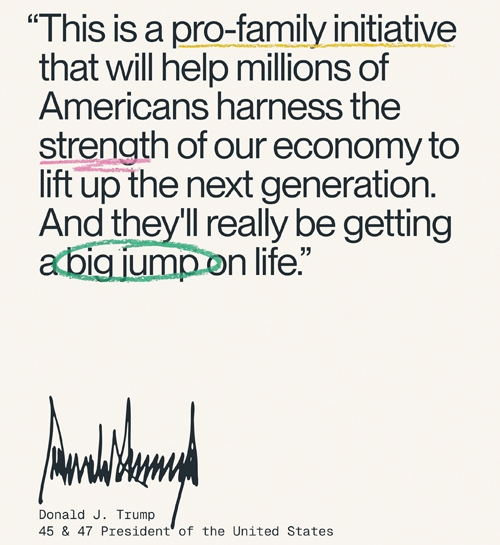
Quoting directly from the whitehouse.gov website, it summarizes the Trump Accounts program as follows:


It should be emphasized that Trump Accounts are available for parents or guardians to open for all of their eligible children who are 17 years old and younger; however, the government only will be depositing $1,000 into the accounts of eligible Trump Account applicants who were born between January 1, 2025 and December 31, 2028 (that is, only those eligible USA babies born during the second term of the Trump Presidency will get the $1,000 government deposit). It is always possible for Congress to extend the eligibility range for the $1,000 automatic deposit to include babies born after December 31, 2028. Parents or guardians should not be deterred from opening a Trump Account for their eligible children whether or not their children qualify to receive the initial $1,000 automatic government deposit. Their children might be eligible to receive a third-party deposit into their Trump Accounts.
It should be noted that the Trump Accounts program is not new. Long before financier Brad Gerstner became engaged with the Trump Accounts concept, the concept of a Trump Accounts program has existed in one form or another for many years. These alternatives to the Trump Accounts include custodial brokerage accounts, custodial Roth IRAs, 529 savings and investing accounts, and so forth. Some city and state governments, too, have introduced plans to help students finance their future college educations after graduating from high school. For instance, one notable local governmental approach to offset the financial challenge faced by low-income residents living in the city of San Francisco is the Kindergarten to College (K2C) savings program. Professor Michael Sherraden, Ph.D. of Washington University is credited with pioneering the childhood educational savings account concept as one way to alleviate poverty in the USA. An added benefit of programs such as K2C is this: Not only do these kinds of programs help students pay for their college educations but also they instill in students the importance of investing early in life as they observe their account balances grow over the intervening years.
Another notable (but forgotten) pre-Trump Accounts program is the Financial Access at Birth (FAB) plan of 2010 (). The FAB plan was pioneered by Professor Bhagwan Chowdhry, Ph.D. of the University of California at Los Angeles (UCLA). Professor Bhagwan Chowdhry has proposed a very modest savings plan to combat world poverty. Professor Chowdhry proposes that, regarding the newborns of parents who cannot afford to do so, with the birth of each child, $100 USD will be deposited into a bank account to be held in trust for the future educational benefit of the newborn child. After the initial $100 deposit is made, Professor Chowdhry recommends that participating donors make additional $10 USD monthly deposits into the account. (See table below for details.) Professor Chowdhry envisions multiple funding sources for the initial $100 one-time deposit as well as for the subsequent $10 monthly deposits (or an additional $120 per year). These funding sources include private citizens, philanthropic organizations, and governments.
| Elapsed Years | Deposit | Interest | Ending balance |
|---|---|---|---|
| 1 | $220.00 | $6.71 | $226.71 |
| 2 | $120.00 | $11.87 | $358.57 |
| 3 | $120.00 | $17.24 | $495.82 |
| 4 | $120.00 | $22.83 | $638.65 |
| 5 | $120.00 | $28.65 | $787.30 |
| 6 | $120.00 | $34.71 | $942.01 |
| 7 | $120.00 | $41.01 | $1,103.02 |
| 8 | $120.00 | $47.57 | $1,270.59 |
| 9 | $120.00 | $54.40 | $1,444.99 |
| 10 | $120.00 | $61.50 | $1,626.49 |
| 11 | $120.00 | $68.90 | $1,815.39 |
| 12 | $120.00 | $76.59 | $2,011.98 |
| 13 | $120.00 | $84.60 | $2,216.58 |
| 14 | $120.00 | $92.94 | $2,429.52 |
| 15 | $120.00 | $101.61 | $2,651.14 |
| 16 | $120.00 | $110.64 | $2,881.78 |
An online calculator was used to create the above FAB table. The above FAB table reveals that the FAB plan should yield an account balance of $2,882 USD after 16 years. This FAB online calculation is based on an initial deposit of $100 USD at birth and additional deposits of $10 USD each month until the end of the 16th year with an interest rate at 4% compounded monthly at the beginning of the period. Again, the FAB table above provides a detailed look at the FAB plan in tabular form.
Professor Chowdhry notes that the account's final balance might turn out to be enough money to pay for the child's college education in a low-income country. Of course, the final account balance of $2,882 USD would not nearly be enough money to pay for a child to attain a college education in a high-income country such as the USA. It is believed that, having attained a college education, the child would proceed to become gainfully employed and self-sufficient throughout adulthood. It also is believed that, when the child completes college and gets married, then his or her children would be less likely to grow up living in poverty. Perhaps even better, not only could the high school graduate in a Third World country use the FAB money to attend a Third World college but also, as an alternative, the high school graduate could use the money in other productive ways such as to start a business or to acquire another type of marketable skill. After all, college is not for everyone. There are multiple career paths or niches for students to pursue in life including the arts (musicians, singers, composers, actors, dancers, sculptors, etc.), sports (soccer, cricket, rugby, hockey, football, baseball, basketball, volleyball, golf, bowling, tennis, swimming, cycling, gymnastics, track & field athletes, etc.), and trades (welder, firefighter, carpenter, plumber, seamtress, chef, barber, automobile mechanic, electrician, gardener, truck driver, etc.).
In essence, Professor Bhagwan Chowdhry's FAB plan expands the national scope of Professor Michael Sherraden's childhood educational savings account idea. Whereas Professor Michael Sherraden's primary concern was to combat national poverty, Professor Bhagwan Chowdhry elevated this idea to a global level by encouraging the world to combat world poverty through the FAB plan. Of course, the key to success—and challenge—for plans such as those proposed by Professor Michael Sherraden and Professor Bhagwan Chowdhry would be for the child to complete high school while receiving fairly decent grades throughout his or her years of attending school to help ensure likely success in college. A central weakness or drawback to Professor Bhagwan Chowdhry's FAB plan is that it does not take inflation or the rising cost of living into consideration over the 16-year period. Most likely, over the course of 16 years, inflation will have eroded the purchasing power of the final FAB account balance not to mention the adverse impact of fees and taxes on the final FAB account balance (assuming no fee exemption or tax exemption is permitted).
According to a 04-April-2026 report by CNBC, it was announced that the Bank of New York Mellon will be the initial trustee for the Trump Accounts. Robinhood has been selected to develop a corresponding Trump Accounts app to track Trump Accounts balances. Because the Trump Accounts program allows trustee-to-trustee transfers, additional trustees are expected to be named.
According to another CNBC report, as of 15-April-2026, the parents or guardians of upwards to 5 million children already have applied for a Trump Account on behalf of their children. Upwards to 1.2 million of those 5 million applicants should be eligible to receive the $1,000 automatic deposit. Not all children living in the USA will be eligible to open a Trump Account based on the eligibility criteria. To meet the eligibility criteria, the child has to be a USA citizen, no more than 17 years old, and has been assigned a valid social security number at the time when the Trump Account application is submitted. The USA Census Bureau and Childstats.gov estimate that, as of 2026, there are upwards to 73,000,000 children living in the USA who are under 18 years old. So, as of 15-April-2026, there are 5,000,000 children who have applied for a Trump Account, and there are 68,000,000 more children who still need to apply (notwithstanding the exclusion of those children who are living in the USA but are non-citizens or undocumented children and those children who do not possess a valid social security number).
According to the website North American Community Hub, approximately 3,600,000 babies were born in the USA in 2024. During the duration of the second Trump Presidency, this 3,600,000 figure provides insight into the yearly upper limit regarding the pool of newborns in the USA who might be eligible to open a Trump account and also who potentially could qualify to receive the initial $1,000, one-time deposit from the USA Treasury. (Note: the CDC and Statista cite statistics similar to the 3,600,000 figure regarding the number of children born each year in the USA.)
THE OBBBA law appropriated $410,000,000 to kickstart the Trump Accounts program. If, say, 5,000,000 of the Trump Accounts applicants were eligible to receive the $1,000 automatic deposit, then the cost of the Trump Accounts program suddenly would skyrocket to $5,000,000,000, thereby, far exceeding the $410,000,000 allocated. The $410,000,000 would cover 410,000 newborns who are eligible to receive the $1,000 automatic deposit.
The Trump Accounts calculations below are not exact (because the impact of inflation, management fees, and taxes are unknown variables that will adversely impact the final balances in the Trump Accounts). The calculations below are close approximations of the final Trump Accounts balances using given fixed assumptions. Also, when performing these types of computations, the precise start date, end date, and terms as recorded by the account trustee are unknown for any given Trump Account. Other unknown variables include the age of the account beneficiary when the account is opened, the number of years the account remains open, periodic deposit amounts and frequencies by parents, third party contributions (by employers, governments, or philanthropies), and so forth. The calculations below only give a good estimation of what the future and final values or account balances will be in the Trump Accounts, say, 18 years or 28 years later after opening the accounts.
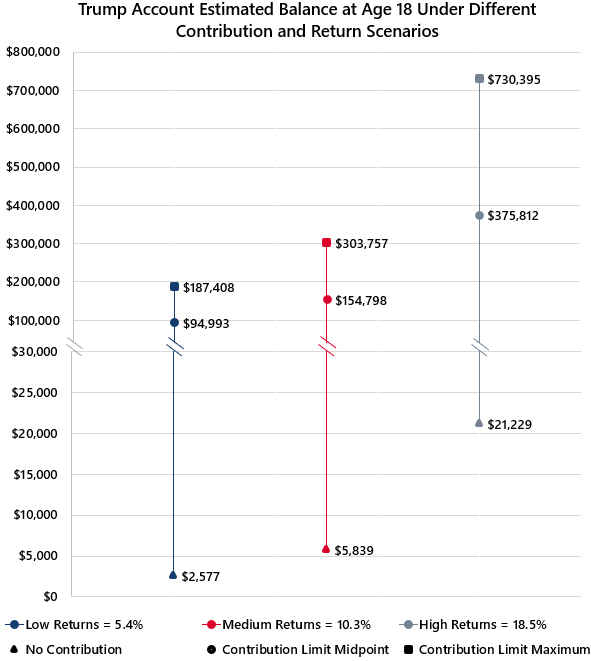
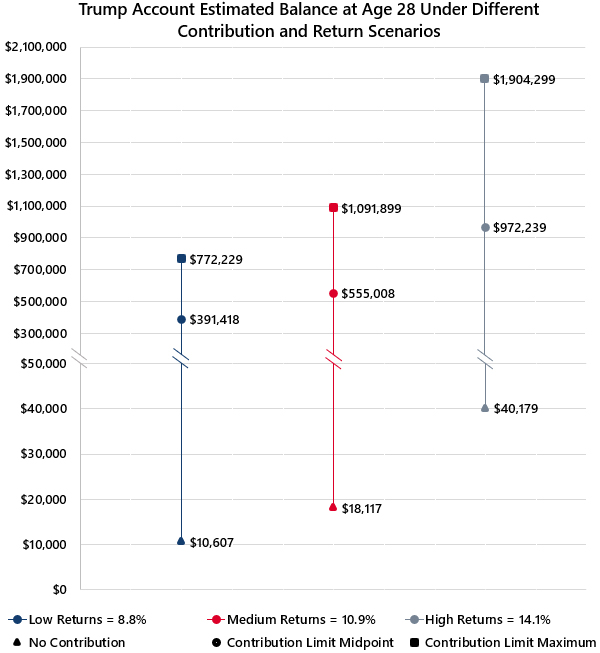
Consider the following two graphics initially presented by the Trump team. They do not comport with reality. It seems as if the two graphics are based on some exaggerated or misleading terms of the investment or some phantom Bernie Madoff type of math to project such specious returns to the Trump Accounts as set forth in the below two graphics. Granted, the document produced by the Trump team states, "The balance of a Trump Account after 18 and 28 years is estimated by computing the minimum, average, and maximum nominal returns on the Total Return S&P 500 over a rolling 18-year and 28-year holding periods ending from 1975 through the present." (See also the pdf titled Trump Accounts Give the Next Generation a Jump Start on Saving.)
Undoubtedly, the Trump Accounts program is a commendable idea. At the same time, it seemed as if either Senator Ted Cruz or someone on the Trump team could have been snorting a little something when they came up with their overly rosy projected returns or account balances as depicted in the next two graphics. Relax, fellas; I am only being facetious about the snorting. But, seriously speaking, perhaps in an effort to please and impress President Donald Trump, most likely, someone decided to embellish the Trump Accounts projected returns or expected account balances as depicted in the next two graphics. To be sure, the estimated account balances in the next two graphics could best be labeled as "fake news."
The following table shows the S&P 500's annual returns since 1926. For instance, based on the table below, the S&P 500's 18-year average return becomes 12.73% for the period from 2008 to 2025. The S&P 500's 28-year average return becomes 10.77% for the period from 1998 to 2025. Generally speaking, it has been noted in other finance articles or blogs that, on average, the S&P 500 produces a return of around 10% to 11%.
| Year | 1926 | 1927 | 1928 | 1929 | 1930 | 1931 | 1932 | 1933 | 1934 | 1935 | Average |
| Total Return | 11.62% | 37.49% | 43.61% | -8.42% | -24.90% | -43.34% | -8.19% | 53.99% | -1.44% | 47.67% | 10.81% |
| Year | 1936 | 1937 | 1938 | 1939 | 1940 | 1941 | 1942 | 1943 | 1944 | 1945 | |
| Total Return | 33.92% | -35.03% | 31.12% | -0.41% | -9.78% | -11.59% | 20.34% | 25.90% | 19.75% | 36.44% | 11.07% |
| Year | 1946 | 1947 | 1948 | 1949 | 1950 | 1951 | 1952 | 1953 | 1954 | 1955 | |
| Total Return | -8.07% | 5.71% | 5.50% | 18.79% | 31.71% | 24.02% | 18.37% | -0.99% | 52.62% | 31.56% | 17.92% |
| Year | 1956 | 1957 | 1958 | 1959 | 1960 | 1961 | 1962 | 1963 | 1964 | 1965 | |
| Total Return | 6.56% | -10.78% | 43.36% | 11.96% | 0.47% | 26.89% | -8.73% | 22.80% | 16.48% | 12.45% | 12.15% |
| Year | 1966 | 1967 | 1968 | 1969 | 1970 | 1971 | 1972 | 1973 | 1974 | 1975 | |
| Total Return | -10.06% | 23.98% | 11.06% | -8.50% | 4.01% | 14.31% | 18.98% | -14.66% | -26.47% | 37.20% | 4.99% |
| Year | 1976 | 1977 | 1978 | 1979 | 1980 | 1981 | 1982 | 1983 | 1984 | 1985 | |
| Total Return | 23.84% | -7.18% | 6.56% | 18.44% | 32.42% | -4.91% | 21.55% | 22.56% | 6.27% | 31.73% | 15.13% |
| Year | 1986 | 1987 | 1988 | 1989 | 1990 | 1991 | 1992 | 1993 | 1994 | 1995 | |
| Total Return | 18.67% | 5.25% | 16.61% | 31.69% | -3.10% | 30.47% | 7.62% | 10.08% | 1.32% | 37.58% | 15.62% |
| Year | 1996 | 1997 | 1998 | 1999 | 2000 | 2001 | 2002 | 2003 | 2004 | 2005 | |
| Total Return | 22.96% | 33.36% | 28.58% | 21.04% | -9.10% | -11.89% | -22.10% | 28.68% | 10.88% | 4.91% | 10.73% |
| Year | 2006 | 2007 | 2008 | 2009 | 2010 | 2011 | 2012 | 2013 | 2014 | 2015 | |
| Total Return | 15.79% | 5.49% | -37.00% | 26.46% | 15.06% | 2.11% | 16.00% | 32.39% | 13.69% | 1.38% | 9.14% |
| Year | 2016 | 2017 | 2018 | 2019 | 2020 | 2021 | 2022 | 2023 | 2024 | 2025 | |
| Total Return | 11.96% | 21.83% | -4.38% | 31.49% | 18.40% | 28.71% | -18.11% | 26.29% | 25.02% | 17.88% | 15.91% |
| Average 1926 through 2025 | 12.35% |
Next, consider the following two graphics, which are based on using Microsoft Excel. The next two Excel combination bar-and-line graphics can be viewed as "real news." Notice how there is an appreciable difference for the final Trump Accounts balances in the next two Excel combination bar-and-line graphics below when compared to the two graphics above, which were produced by the Trump team.
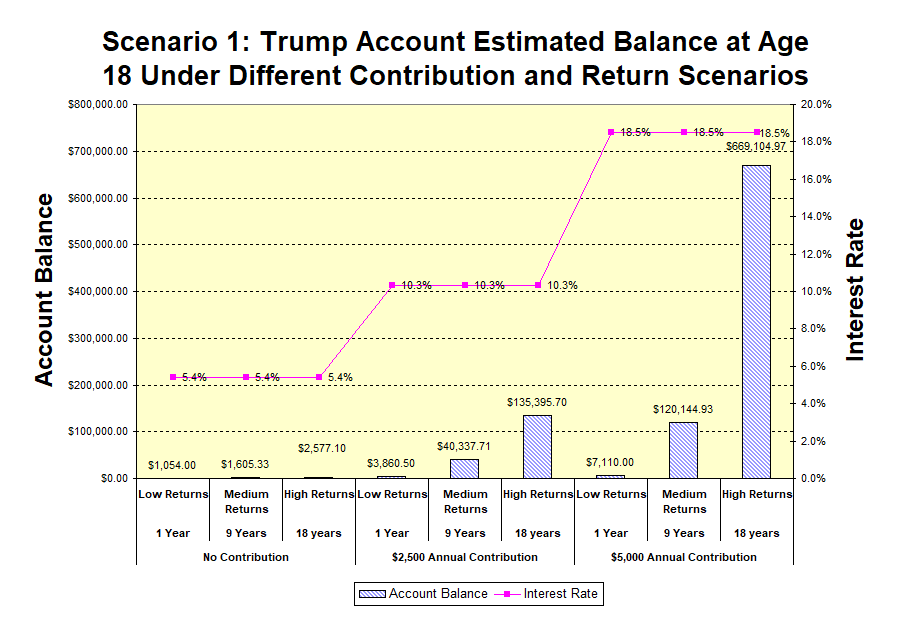
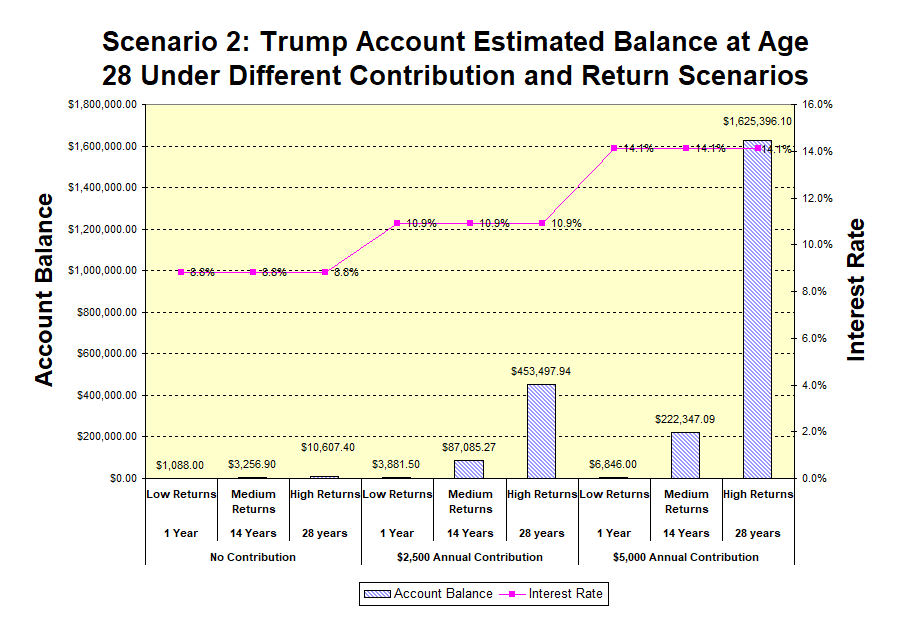
The Excel combination bar-and-line graph values in the above two graphics were computed using an online future-value calculator. The beginning-of-the-period option was used to match the Trump team's balances. Online future-value calculators show a substantially lower final account balance compared to the Trump team's two graphics above. For instance, based on the assumptions or terms of the accounts used by the Trump team, the Trump team's Scenario 1 shows an account balance of $187,408 after 18 years using a 5.4% interest rate and no subsequent contributions to the account. In reality, this particular account's balance would be $2,577.10 after 18 years. In Scenario 2, based on the assumptions or terms of the accounts used by the Trump team, the Trump team shows an account balance of $772,229 after 28 years using an 8.8% interest rate and no subsequent contributions to the account. In reality, this particular account's balance would be $10,607.40 after 28 years.
Keep in mind that the above Trump Accounts balances, as depicted in the two graphics above, do not take into consideration the adverse impacts that inflation, management fees, and withdrawal taxes will have on reducing the final Trump Accounts balances, say, 18, 28, 55, or 65 years into the future. Inflation poses the biggest adverse threat for substantially reducing the future purchasing power in the final Trump Accounts balances. For example, using the following inflation formula
Present Value = [Future Amount ÷ (1 + Inflation Rate)Elapsed Years)]
and given the account terms stipulated by the Trump team's Scenario 1 above, and also assuming an inflation rate of 2.4%, the first table below indicates that a computed final Trump Account balance of $2,577.10 would actually yield an equivalent purchasing power of $1,681.64 at the end of 18 years into the future. Similarly, given the account terms stipulated by the Trump team's Scenario 2 above, after adjusting for an assumed 2.4% inflation rate, the second table below indicates that a computed final Trump Account balance of $10,607.40 would actually yield an equivalent purchasing power of $5,460.22 at the end of 28 years into the future. To offset the adverse impact of inflation, the OBBBA does have a provision for the $5,000 contribution limit to be increased each year based on increases in the cost of living.
| Elapsed Years | Principal | Interest Earned at 5.4% at the Beginning of the Period | Total Account Balance | Adjusted Account Balance Less Inflation's Impact (Assuming a 2.4% Inflation Rate Adjustment) |
|---|---|---|---|---|
| 1 | $1,000.00 | $54.00 | $1,054.00 | $1,029.30 |
| 2 | $1,000.00 | $110.92 | $1,110.92 | $1,059.46 |
| 3 | $1,000.00 | $170.91 | $1,170.91 | $1,090.49 |
| 4 | $1,000.00 | $234.13 | $1,234.13 | $1,122.43 |
| 5 | $1,000.00 | $300.78 | $1,300.78 | $1,155.32 |
| 6 | $1,000.00 | $371.02 | $1,371.02 | $1,189.17 |
| 7 | $1,000.00 | $445.05 | $1,445.05 | $1,224.00 |
| 8 | $1,000.00 | $523.09 | $1,523.09 | $1,259.87 |
| 9 | $1,000.00 | $605.33 | $1,605.33 | $1,296.78 |
| 10 | $1,000.00 | $692.02 | $1,692.02 | $1,334.77 |
| 11 | $1,000.00 | $783.39 | $1,783.39 | $1,373.87 |
| 12 | $1,000.00 | $879.69 | $1,879.69 | $1,414.12 |
| 13 | $1,000.00 | $981.20 | $1,981.20 | $1,455.56 |
| 14 | $1,000.00 | $1,088.18 | $2,088.18 | $1,498.20 |
| 15 | $1,000.00 | $1,200.94 | $2,200.94 | $1,542.09 |
| 16 | $1,000.00 | $1,319.80 | $2,319.80 | $1,587.27 |
| 17 | $1,000.00 | $1,445.06 | $2,445.06 | $1,633.77 |
| 18 | $1,000.00 | $1,577.10 | $2,577.10 | $1,681.64 |
| Elapsed Years | Principal | Interest Earned at 8.8% at the Beginning of the Period | Total Account Balance | Adjusted Account Balance Less Inflation's Impact (Assuming a 2.4% Inflation Rate Adjustment) |
|---|---|---|---|---|
| 1 | $1,000.00 | $88.00 | $1,088.00 | $1,062.50 |
| 2 | $1,088.00 | $95.74 | $1,183.74 | $1,128.90 |
| 3 | $1,183.74 | $104.17 | $1,287.91 | $1,199.46 |
| 4 | $1,287.91 | $113.34 | $1,401.25 | $1,274.43 |
| 5 | $1,401.25 | $123.31 | $1,524.56 | $1,354.08 |
| 6 | $1,524.56 | $134.16 | $1,658.72 | $1,438.71 |
| 7 | $1,658.72 | $145.97 | $1,804.69 | $1,528.63 |
| 8 | $1,804.69 | $158.81 | $1,963.50 | $1,624.17 |
| 9 | $1,963.50 | $172.79 | $2,136.29 | $1,725.68 |
| 10 | $2,136.29 | $187.99 | $2,324.28 | $1,833.53 |
| 11 | $2,324.28 | $204.54 | $2,528.82 | $1,948.13 |
| 12 | $2,528.82 | $222.54 | $2,751.36 | $2,069.89 |
| 13 | $2,751.36 | $242.12 | $2,993.48 | $2,199.26 |
| 14 | $2,993.48 | $263.43 | $3,256.90 | $2,336.71 |
| 15 | $3,256.90 | $286.61 | $3,543.51 | $2,482.76 |
| 16 | $3,543.51 | $311.83 | $3,855.34 | $2,637.93 |
| 17 | $3,855.34 | $339.27 | $4,194.61 | $2,802.80 |
| 18 | $4,194.61 | $369.13 | $4,563.73 | $2,977.97 |
| 19 | $4,563.73 | $401.61 | $4,965.34 | $3,164.10 |
| 20 | $4,965.34 | $436.95 | $5,402.29 | $3,361.85 |
| 21 | $5,402.29 | $475.40 | $5,877.69 | $3,571.97 |
| 22 | $5,877.69 | $517.24 | $6,394.93 | $3,795.22 |
| 23 | $6,394.93 | $562.75 | $6,957.68 | $4,032.42 |
| 24 | $6,957.68 | $612.28 | $7,569.96 | $4,284.45 |
| 25 | $7,569.96 | $666.16 | $8,236.11 | $4,552.22 |
| 26 | $8,236.11 | $724.78 | $8,960.89 | $4,836.73 |
| 27 | $8,960.89 | $788.56 | $9,749.45 | $5,139.03 |
| 28 | $9,749.45 | $857.95 | $10,607.40 | $5,460.22 |
The next graphic brings into sharper focus exactly how inflation in today's money erodes future purchasing power with the passage of time. In the graphic, the year 2010 would represent today's money. The year 2022 would represent the erosion of purchasing power 12 years later due to the adverse impact of inflation (assuming no comparable rise in wages or salaries to offset the adverse impact of inflation). Again, to offset inflation's adverse impact on the Trump Accounts balances, the OBBBA does have a provision for the $5,000 contribution limit to be increased each year based on increases in the cost of living.
![30.04.2022 - Portuguese (Brazil): Ex-presidente Lula discute o custo de vida e o direito à alimentação em encontro com mulheres na Brasilândia, em São Paulo, e observa carrinhos com alimentos comprados por R$100,00 em 2010 e em 2022. Janja, Gleisi Hoffmann e Fernando Haddad participaram do encontro. Foto: Ricardo Stuckert [English Translation: Former President Lula discusses the cost of living and the right to food in a meeting with women in Brasilândia, in São Paulo, and observes carts with food bought for R$100.00 in 2010 and 2022. Janja, Gleisi Hoffmann and Fernando Haddad participated in the meeting. Photo: Ricardo Stuckert] | commons.wikimedia.org | Source: President Lula at flickr.com](/pub/2027/images/inflation-52302798877-30.04.2022.jpg "30.04.2022 - Portuguese (Brazil): Ex-presidente Lula discute o custo de vida e o direito à alimentação em encontro com mulheres na Brasilândia, em São Paulo, e observa carrinhos com alimentos comprados por R$100,00 em 2010 e em 2022. Janja, Gleisi Hoffmann e Fernando Haddad participaram do encontro. Foto: Ricardo Stuckert [English Translation: Former President Lula discusses the cost of living and the right to food in a meeting with women in Brasilândia, in São Paulo, and observes carts with food bought for R$100.00 in 2010 and 2022. Janja, Gleisi Hoffmann and Fernando Haddad participated in the meeting. Photo: Ricardo Stuckert] | commons.wikimedia.org | Source: President Lula at flickr.com")
The next two graphics contain the actual interest rates that the account beneficiary would need to receive if the account beneficiary is to attain the types of returns or final account balances depicted in the Trump team's two "fake news" graphics above. The next two graphics also were computed using an online rate of return calculator. In those instances whereby the rate of return is negative in the next two graphics below, it would mean that the account loss money (that is, based on the assumed terms of the account, the final account balance given by the Trump team, and the assumed annual contribution amounts). For instance, if the final Trump Account balance is $21,229 but a sum of $5,000 was contributed each year for 18 years, then the $90,000 in total contributions alone would exceed the final balance of $21,229. Omni Calculator's future-value calculator can be used to verify the actual interest rates depicted as red percentages in the two graphics below.
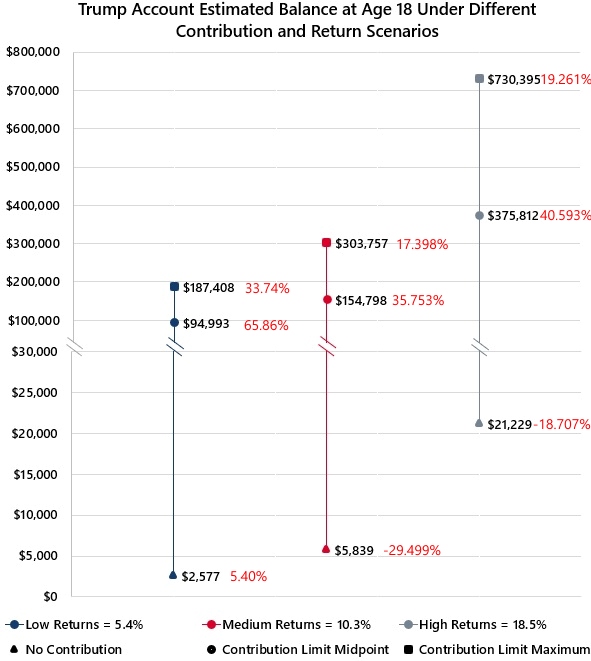
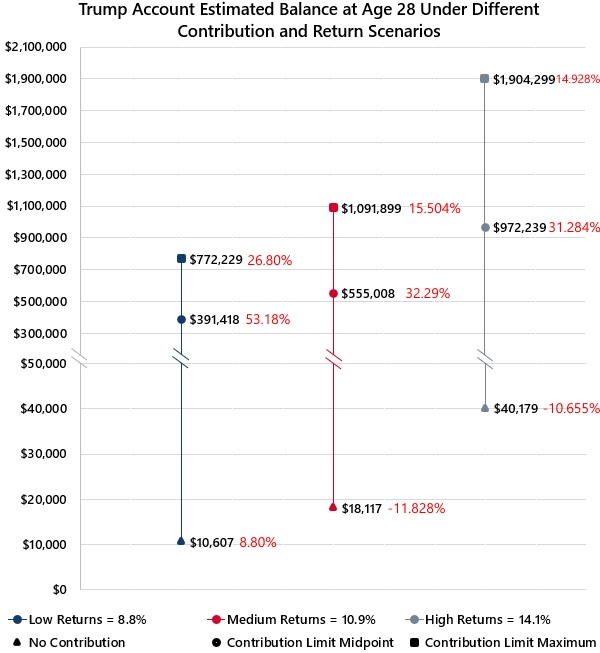
The true account balances in the two Excel combination bar-and-line graphics above were derived by using an online future-value calculator. Despite the differences in final Trump Accounts balances derived by the Trump team in their two graphics above when compared to computations in the two Excel combination bar-and-line graphics above—and they are some substantial differences—sight should not be lost of two very important facts:


A third important fact is this: When saving for their children's future, parents may wish to consider exploring the various other investment/savings alternatives mentioned above—such as custodial brokerage accounts, custodial Roth IRAs, and 529 savings and investing accounts. For instance, on his blog page, attorney Ryan Reiffert mentioned an array of alternative accounts. He performed a comparison between the Trump Account and the 529 Plan. His comparison indicated that the 529 Plan was a more attractive long-term savings option for parents to pursue on behalf of their children in terms of college savings acccounts—albeit the 529 Plan monies are meant to be spent exclusively to attend college whereas, say, the money acccumulated in a custodial brokerage account could be used to pay for anything. In another article, JPMorgan Chase performed a similar side-by-side comparison of Trump Accounts to the 529 Plan and to the custodial brokerage account.
At the same time, it is of uppermost importance to emphasize that a Trump Account represents free money for the future benefit of children—even for those children opening accounts at staggered ages, say, at 13-, 14-, or 15-years old who might not reap the full benefit of compound interest. Rhetorically, who says, "no," to free money? Therefore, a Trump Account should be opened by parents or guardians for their eligible children even if the Trump Account only will serve as a secondary or supplementary savings vehicle for their children's future economic benefit. Indeed, notwithstanding the exaggerated returns mentioned in the two Trump team graphics above and notwithstanding the Trump Accounts shortcomings mentioned by those such as attorney Ryan Reiffert, another deficiency mentioned about the Trump Accounts program is that it does not provide a mechanism for automatic enrollment of all eligible newborns into a Trump Account. It is not the newborn's fault and the newborn should not be penalized simply because the newborn's parents did not take the initiative to enroll their newborns into a free Trump Account. It also has been noted that poorer parents of newborns would least likely to be in a financial position to make contributions to their children's Trump Accounts. This reality makes the Trump Accounts program a more lucrative and advantageous investment vehicle for those parents or guardians who have the financial means to make the maximum annual contributions to their children's Trump Accounts. The more parents are able to contribute to Trump Accounts, the more money will accumulate in the accounts over time. This scenario remind me of the adage that says, "It takes money to make money." Similarly, the sooner in life that children are enrolled, the more money will accumulate in the accounts over time.
Thinking outside the box, one possible remedy to boost participation in the Trump Accounts program by all parents with eligible children is for hospitals to provide, make available, or distribute Trump Accounts enrollment literature (with easy-to-follow enrollment instructions) to all expecting mothers before and after giving birth. Another possible way to spread the word about the Trump Accounts program is for the USA government, say, the Census Bureau, to engage the USA Postal Service to mail Trump Accounts literature to all household addresses. Another possibility to boost awareness and participation in the Trump Accounts program is for the government to blanket the various media outlets (print, radio, television, cellular phone, online, and so forth) with advertisements promoting the Trump Accounts program. Schools also could provide Trump Accounts program literature to parents. Politicians are quite adept at reaching out to voters to solicit campaign contributions and/or to solicit their votes. These same types of outreach mechanisms could be deployed to encourage parents to enroll their eligible children in the Trump Accounts program.
Finally, it should be noted here that the trumpaccounts.gov website does provide accurate projections of expected account balances after 18, 27, and 55 years have elapsed, respectively, after opening a Trump Account. These accurate projections are shown in the three examples immediately below.
It should be noted that these Trump Account balances will grow even higher than depicted in the above three examples for account beneficiaries who have reached 18, 27, and 55 years old if third parties should decide to make annual contributions to the accounts. For example, these third parties might include employers, charities, philanthropies, and state and local governments. Some third parties already have pledged to participate and contribute to the Trump Accounts program. It will be very exciting to see the Trump Accounts balances grow over time from the initial $1,000 USA government deposit (hence, taxpayer deposit). The Trump Accounts program should prove to be an economic boom and an outstanding example of well-spent taxpayer monies especially if all eligible newborns could be enrolled in the program and if more third partiesdecided to contribute to the program.
The trumpaccounts.guide website has released an array of free Trump Accounts-related calculators to gauge the outcome of various Trump Accounts strategies. Below is one of these free trumpaccounts.guide calculators.
Trump Account Calculator by TrumpAccounts.guide


Below is an excerpt from the OBBBA law. The excerpt below only pertains to the Trump Accounts part of the OBBBA law. Some reports refer to Trump Accounts as 530A accounts simply to be consistent with SEC. 530A below of the OBBBA law.
OBBBA EXCERPT—PUBLIC LAW 119–21—JULY 4, 2025 139 STAT. 75
Source: govinfo.gov [Congressional Bills 119th Congress] [From the U.S. Government Publishing Office] [H.R. 1 Enrolled Bill (ENR)] H.R.1 One Hundred Nineteenth Congress of the United States of America AT THE FIRST SESSION Begun and held at the City of Washington on Friday, the third day of January, two thousand and twenty-five An Act To provide for reconciliation pursuant to title II of H. Con. Res. 14. Be it enacted by the Senate and House of Representatives of the United States of America in Congress assembled, SECTION 1. TABLE OF CONTENTS. The table of contents of this Act is as follows: Sec. 1. Table of contents. TITLE VII—FINANCE Chapter 2—Delivering on Presidential Priorities to Provide New Middle- class Tax Relief Sec. 70204. Trump accounts and contribution pilot program.TITLE VII—FINANCE
CHAPTER 2—DELIVERING ON PRESIDENTIAL PRIORITIES TO PROVIDE NEW MIDDLE-CLASS TAX RELIEF
SEC. 70204. TRUMP ACCOUNTS AND CONTRIBUTION PILOT PROGRAM. (a) Trump Accounts.— (1) In general.—Subchapter F of chapter 1 is amended by adding at the end the following new part: "PART IX—TRUMP ACCOUNTSSEC. 530A. TRUMP ACCOUNTS.
"(a) General Rule.—Except as provided in this section or under regulations or guidance established by the Secretary, a Trump account shall be treated for purposes of this title in the same manner as an individual retirement account under section 408(a). "(b) Trump Account.—For purposes of this section— "(1) In general.—The term 'Trump account' means an individual retirement account (as defined in section 408(a)) which is not designated as a Roth IRA and which meets the following requirements: "(A) The account— "(i) is created or organized by the Secretary for the exclusive benefit of an eligible individual or such eligible individual's beneficiaries, or "(ii) is— "(I) created or organized in the United States for the exclusive benefit of an individual who has not attained the age of 18 before the end of the calendar year, or such individual's beneficiaries, and "(II) funded by a qualified rollover contribution. "(B) The account is designated (in such manner as the Secretary shall prescribe) at the time of the establishment of the account as a Trump account. "(C) The written governing instrument creating the account meets the following requirements: "(i) No contribution will be accepted— "(I) before the date that is 12 months after the date of the enactment of this section, or "(II) in the case of a contribution made in any calendar year before the calendar year in which the account beneficiary attains age 18, if such contribution would result in aggregate contributions (other than exempt contributions) for such calendar year in excess of the contribution limit specified in subsection (c)(2)(A). "(ii) Except as provided in subsection (d), no distribution will be allowed before the first day of the calendar year in which the account beneficiary attains age 18. "(iii) No part of the account funds will be invested in any asset other than an eligible investment during any period before the first day of the calendar year in which the account beneficiary attains age 18. "(2) Eligible individual.—The term 'eligible individual' means any individual— "(A) who has not attained the age of 18 before the close of the calendar year in which the election under subparagraph (C) is made, "(B) for whom a social security number (within the meaning of section 24(h)(7)) has been issued before the date on which an election under subsection (C) is made, and "(C) for whom— "(i) an election is made under this subparagraph by the Secretary if the Secretary determines (based on information available to the Secretary from tax returns or otherwise) that such individual meets the requirements of subparagraphs (A) and (B) and no prior election has been made for such individual under clause (ii), or "(ii) an election is made under this subparagraph by a person other than the Secretary (at such time and in such manner as the Secretary may prescribe) for the establishment of a Trump account if no prior election has been made for such individual under clause (i). "(3) Eligible investment.— "(A) In general.—The term 'eligible investment' means any mutual fund or exchange traded fund which— "(i) tracks the returns of a qualified index, "(ii) does not use leverage, "(iii) does not have annual fees and expenses of more than 0.1 percent of the balance of the investment in the fund, and "(iv) meets such other criteria as the Secretary determines appropriate for purposes of this section. "(B) Qualified index.—The term 'qualified index' means— "(i) the Standard and Poor's 500 stock market index, or "(ii) any other index— "(I) which is comprised of equity investments in primarily United States companies, and "(II) for which regulated futures contracts (as defined in section 1256(g)(1)) are traded on a qualified board or exchange (as defined in section 1256(g)(7)). Such term shall not include any industry or sector-specific index, but may include an index based on market capitalization. "(4) Account beneficiary.—The term 'account beneficiary' means the individual on whose behalf the Trump account was established. "(c) Treatment of Contributions.— "(1) No deduction allowed.—No deduction shall be allowed under section 219 for any contribution which is made before the first day of the calendar year in which the account beneficiary attains age 18. "(2) Contribution limit.—In the case of any contribution made before the calendar year in which the account beneficiary attains age 18— "(A) In general.—The aggregate amount of contributions (other than exempt contributions) for such calendar year shall not exceed $5,000. "(B) Exempt contribution.—For purposes of this paragraph, the term 'exempt contribution' means— "(i) a qualified rollover contribution, "(ii) any qualified general contribution, or "(iii) any contribution provided under section 6434. "(C) Cost-of-living adjustment.— "(i) In general.—In the case of any taxable year after 2027, the $5,000 amount under subparagraph (A) shall be increased by an amount equal to— "(I) such dollar amount, multiplied by "(II) the cost-of-living adjustment determined under section 1(f)(3) for the calendar year in which the taxable year begins, determined by substituting 'calendar year 2026' for 'calendar year 2016' in subparagraph (A)(ii) thereof. "(ii) Rounding.—If any increase under this subparagraph is not a multiple of $100, such amount shall be rounded to the next lowest multiple of $100. "(3) Timing of contributions.—Section 219(f)(3) shall not apply to any contribution made to a Trump account for any taxable year ending before the calendar year in which the account beneficiary attains age 18. "(d) Distributions.— "(1) In general.—Except as otherwise provided in this subsection, no distribution shall be allowed before the first day of the calendar year in which the account beneficiary attains age 18. "(2) Tax treatment of allowable distributions.—For purposes of applying section 72 to any amount distributed from a Trump account, the investment in the contract shall not include— "(A) any qualified general contribution, "(B) any contribution provided under section 6434, and "(C) the amount of any contribution which is excluded from gross income under section 128. "(3) Qualified rollover contributions.—Paragraph (1) shall not apply to any distribution which is a qualified rollover contribution and the amount of such distribution shall not be included in the gross income of the beneficiary. "(4) Qualified able rollover contributions.— "(A) In general.—Paragraph (1) shall not apply to any distribution which is a qualified ABLE rollover contribution and the amount of such distribution shall not be included in the gross income of the beneficiary. "(B) Qualified able rollover contribution.—For purposes of this section, the term 'qualified ABLE rollover contribution' means an amount which is paid during the calendar year in which the account beneficiary attains age 17 in a direct trustee-to-trustee transfer from a Trump account maintained for the benefit of the account beneficiary to an ABLE account (as defined in section 529A(e)(6)) for the benefit of the such account beneficiary, but only if the amount of such payment is equal to the entire balance of the Trump account from which the payment is made. "(5) Distributions of excess contributions.—In the case of any contribution which is made before the calendar year in which the account beneficiary attains age 18 and which is in excess of the limitation in effect under subsection (c)(2)(A) for the calendar year— "(A) paragraph (1) shall not apply to the distribution of such excess, "(B) the amount of such distribution shall not be included in gross income of the account beneficiary, and "(C) the tax imposed by this chapter on the distributee for the taxable year in which the distribution is made shall be increased by 100 percent of the amount of net income attributable to such excess (determined without regard to subparagraph (B)). "(6) Treatment of death of account beneficiary.—If, by reason of the death of the account beneficiary before the first day of the calendar year in which the account beneficiary attains age 18, any person acquires the account beneficiary's interest in the Trump account— "(A) paragraph (1) shall not apply, "(B) such account shall cease to be a Trump account as of the date of death, and "(C) an amount equal to the fair market value of the assets (reduced by the investment in the contract) in such account on such date shall— "(i) if such person is not the estate of such beneficiary, be includible in such person's gross income for the taxable year which includes such date, or "(ii) if such person is the estate of such beneficiary, be includible in such beneficiary's gross income for the last taxable year of such beneficiary. "(e) Qualified Rollover Contribution.—For purposes of this section, the term 'qualified rollover contribution' means an amount which is paid in a direct trustee-to-trustee transfer from a Trump account maintained for the benefit of the account beneficiary to a Trump account maintained for such beneficiary, but only if the amount of such payment is equal to the entire balance of the Trump account from which the payment is made. "(f) Qualified General Contribution.—For purposes of this section— "(1) In general.—The term 'qualified general contribution' means any contribution which— "(A) is made by the Secretary pursuant to a general funding contribution, "(B) is made to the Trump account of an account beneficiary in the qualified class of account beneficiaries specified in the general funding contribution, and "(C) is in an amount which is equal to the ratio of— "(i) the amount of such general funding contribution, to "(ii) the number of account beneficiaries in such qualified class. "(2) General funding contribution.—The term 'general funding contribution' means a contribution which— "(A) is made by— "(i) an entity described in section 170(c)(1) (other than a possession of the United States or a political subdivision thereof) or an Indian tribal government, or "(ii) an organization described in section 501(c)(3) and exempt from tax under section 501(a), and "(B) which specifies a qualified class of account beneficiaries to whom such contribution is to be distributed. "(3) Qualified class.— "(A) In general.—The term 'qualified class' means any of the following: "(i) All account beneficiaries who have not attained the age of 18 before the close of the calendar year in which the contribution is made. "(ii) All account beneficiaries who have not attained the age of 18 before the close of the calendar year in which the contribution is made and who reside in one or more States or other qualified geographic areas specified by the terms of the general funding contribution. "(iii) All account beneficiaries who have not attained the age of 18 before the close of the calendar year in which the contribution is made and who were born in one or more calendar years specified by the terms of the general funding contribution. "(B) Qualified geographic area.—The term 'qualified geographic area' means any geographic area in which not less than 5,000 account beneficiaries reside and which is designated by the Secretary as a qualified geographic area under this subparagraph. "(g) Trustee Selection.—In the case of any Trump account created or organized by the Secretary, the Secretary shall take into account the following criteria in selecting the trustee: "(1) The history of reliability and regulatory compliance of the trustee. "(2) The customer service experience of the trustee. "(3) The costs imposed by the trustee on the account or the account beneficiary. "(h) Other Special Rules and Coordination With Individual Retirement Account Rules.— "(1) In general.—The rules of subsections (k) and (p) of section 408 shall not apply to a Trump account, and the rules of subsections (d) and (i) of section 408 shall not apply to a Trump account for any taxable year beginning before the calendar year in which the account beneficiary attains age 18. "(2) Custodial accounts.—In the case of a Trump account, section 408(h) shall be applied by substituting 'a Trump account described in section 530A(b)(1)' for 'an individual retirement account described in subsection (a)'. "(3) Contributions.—In the case of any taxable year beginning before the first day of the calendar year in which the account beneficiary attains age 18, a contribution to a Trump account shall not be taken into account in applying any contribution limit to any individual retirement plan other than a Trump account. "(4) Distributions.—Section 408(d)(2) shall be applied separately with respect to Trump Accounts and other individual retirement plans. "(5) Excess contributions.—For purposes of applying section 4973(b) to a Trump account for any taxable year beginning before the first day of the calendar year in which the account beneficiary attains age 18, the term 'excess contributions' means the sum of— "(A) the amount by which the amount contributed to the account for the calendar year in which taxable year begins exceeds the amount permitted to be contributed to the account under subsection (c)(2), and "(B) the amount determined under this paragraph for the preceding taxable year. For purposes of this paragraph, the excess contributions for a taxable year are reduced by the distributions to which subsection (d)(5) applies that are made during the taxable year or by the date prescribed by law (including extensions of time) for filing the account beneficiary's return for the taxable year. "(i) Reports.— "(1) In general.—The trustee of a Trump account shall make such reports regarding such account to the Secretary and to the beneficiary of the account at such time and in such manner as may be required by the Secretary. Such reports shall include information with respect to— "(A) contributions (including the amount and source of any contribution in excess of $25 made from a person other than the Secretary, the account beneficiary, or the parent or legal guardian of the account beneficiary), "(B) distributions (including distributions which are qualified rollover contributions), "(C) the fair market value of the account, "(D) the investment in the contract with respect to such account, and "(E) such other matters as the Secretary may require. "(2) Qualified rollover contributions.—Not later than 30 days after the date of any qualified rollover contribution, the trustee of the Trump account to which the contribution was made shall make a report to the Secretary. Such report shall include— "(A) the name, address, and social security number of the account beneficiary, "(B) the name and address of such trustee, "(C) the account number, "(D) the routing number of the trustee, and "(E) such other information as the Secretary may require. "(3) Period of reporting.—This subsection shall not apply to any period after the calendar year in which the beneficiary attains age 17.". (2) Qualified able rollover contributions exempt from able contribution limitation.— (A) In general.—Section 529A(b)(2)(B) is amended by inserting "or received in a qualified ABLE rollover contribution described in section 530A(d)(4)(B)" after "except as provided in the case of contributions under subsection (c)(1)(C)". (B) Prohibition on excess contributions.—The second sentence of section 529A(b)(6) is amended by inserting "but do not include any contributions received in a qualified ABLE rollover contribution described in section 530A(d)(4)(B)" before the period at the end. (C) Conforming amendment.—Section 4973(h)(1) is amended by inserting "or contributions received in a qualified ABLE rollover contribution described in section 530A(d)(4)(B)" after "other than contributions under section 529A(c)(1)(C)". (3) Failure to provide reports on trump accounts.—Section 6693(a)(2) is amended by striking "and" at the end of subparagraph (E), by striking the period at the end of subparagraph (F) and inserting ", and", and by inserting after subparagraph (F) the following new subparagraph: "(G) section 530A(i) (relating to Trump accounts).". (4) Clerical amendment.— (A) The table of parts for subchapter F of chapter 1 is amended by adding at the end the following new item: (b) Employer Contributions.— (1) In general.—Part III of subchapter B of chapter 1 is amended by inserting after section 127 the following new section: Go to Table of Content - Section 530ASEC. 128. EMPLOYER CONTRIBUTIONS TO TRUMP ACCOUNTS.
"(a) In General.—Gross income of an employee does not include amounts paid by the employer as a contribution to the Trump account of such employee or of any dependent of such employee if the amounts are paid or incurred pursuant to a program which is described in subsection (c). "(b) Limitation.— "(1) In general.—The amount which may be excluded under subsection (a) with respect to any employee shall not exceed $2,500. "(2) Inflation adjustment.— "(A) In general.—In the case of any taxable year beginning after 2027, the $2,500 amount in paragraph (1) shall be increased by an amount equal to— "(i) such dollar amount, multiplied by "(ii) the cost-of-living adjustment determined under section 1(f)(3) for the calendar year in which the taxable year begins by substituting 'calendar year 2026' for 'calendar year 2016' in subparagraph (A)(ii) thereof. "(B) Rounding.—If any increase determined under subparagraph (A) is not a multiple of $100, such increase shall be rounded to the next lowest multiple of $100. "(c) Trump Account Contribution Program.—For purposes of this section, a Trump account contribution program is a separate written plan of an employer for the exclusive benefit of his employees to provide contributions to the Trump accounts of such employees or dependents of such employees which meets requirements similar to the requirements of paragraphs (2), (3), (6), (7), and (8) of section 129(d).". (2) Clerical amendment.—The table of sections for part III of subchapter B of chapter 1 is amended by inserting after the item relating to section 127 the following new item: (c) Certain Contributions Excluded From Gross Income.— (1) In general.—Part III of subchapter B of chapter 1 is amended by inserting before section 140 the following new section: Go to Table of Content - Section 128SEC. 139J. CERTAIN CONTRIBUTIONS TO TRUMP ACCOUNTS.
"(a) In General.—Gross income of an account beneficiary shall not include any qualified general contribution to a Trump account of the account beneficiary. "(b) Definitions.—Any term used in this section which is used in section 530A shall have the meaning given such term under section 530A.". (2) Clerical amendment.—The table of sections for part III of subchapter B is amended by inserting before the item relating to section 140 the following new item: (d) Trump Accounts Contribution Pilot Program.— (1) In general.—Subchapter B of chapter 65 is amended by adding at the end the following new section: Go to Table of Content - Section 139JSEC. 6434. TRUMP ACCOUNTS CONTRIBUTION PILOT PROGRAM.
"(a) In General.—In the case of an individual who makes an election under this section with respect to an eligible child of the individual, such eligible child shall be treated as making a payment against the tax imposed by subtitle A (for the taxable year for which the election was made) in an amount equal to $1,000. "(b) Refund of Payment.—The amount treated as a payment under subsection (a) shall be paid by the Secretary to the Trump account with respect to which such eligible child is the account beneficiary. "(c) Eligible Child.—For purposes of this section, the term 'eligible child' means a qualifying child (as defined in section 152(c))— "(1) who is born after December 31, 2024, and before January 1, 2029, "(2) with respect to whom no prior election has been made under this section by such individual or any other individual, and "(3) who is a United States citizen. "(d) Election.—An election under this section shall be made at such time and in such manner as the Secretary shall provide. "(e) Social Security Number Required.— "(1) In general.—This section shall not apply to any taxpayer unless such individual includes with the election made under this section the social security number of the eligible child with respect to whom the election is made. "(2) Social security number defined.—For purposes of paragraph (1), the term 'social security number' shall have the meaning given such term in section 24(h)(7), determined by substituting 'before the date of the election made under section 6434' for 'before the due date of such return' in subparagraph (B) thereof. "(f) Exception From Reduction or Offset.—Any payment made to any individual under this section shall not be— "(1) subject to reduction or offset pursuant to subsection (c), (d), (e), or (f) of section 6402 or any similar authority permitting offset, or "(2) reduced or offset by other assessed Federal taxes that would otherwise be subject to levy or collection. "(g) Special Rule Regarding Interest.—The period determined under section 6611(a) with respect to any payment under this section shall not begin before January 1, 2028. "(h) Mirror Code Possessions.—In the case of any possession of the United States with a mirror code tax system (as defined in section 24(k)), this section shall not be treated as part of the income tax laws of the United States for purposes of determining the income tax law of such possession unless such possession elects to have this section be so treated. "(i) Definitions.—For purposes of this section, the terms 'Trump account' and 'account beneficiary' have the meaning given such terms in section 530A(b).". (2) Penalty for negligent claim or fraudulent claim.—Part I of subchapter A of chapter 68 is amended by adding at the end the following new section: Go to Table of Content - Section 6434SEC. 6659. IMPROPER CLAIM FOR TRUMP ACCOUNT CONTRIBUTION PILOT PROGRAM CREDIT.
"(a) In General.—In the case of any individual who makes an election under section 6434 with respect to an individual who is not an eligible child of the taxpayer— "(1) if such election was made due to negligence or disregard of the rules or regulations, there shall be imposed a penalty of $500, or "(2) if such election was made due to fraud, there shall be imposed a penalty of $1,000. "(b) Definitions.— "(1) Eligible child.—The term 'eligible child' has the meaning given such term under section 6434. "(2) Negligence; disregard.—The terms 'negligence' and 'disregard' have the same meaning as when such terms are used in section 6662.". (3) Omission of correct social security number treated as mathematical or clerical error.—Section 6213(g)(2), as amended by the preceding provisions of this Act, is amended by striking "and" at the end of subparagraph (Y), by striking the period at the end of subparagraph (Z) and inserting ", and", and by inserting after subparagraph (Z) the following new subparagraph: "(AA) an omission of a correct social security number required under section 6434(e)(1) (relating to the Trump accounts contribution pilot program).". (4) Conforming amendments.— (A) The table of sections for subchapter B of chapter 65 is amended by adding at the end the following new item: "Sec. 6434. Trump accounts contribution pilot program.". (B) The table of sections for part I of subchapter A of chapter 68 is amended by inserting after the item relating to section 6658 the following new item: "Sec. 6659. Improper claim for Trump account contribution pilot program credit.". (e) Effective Date.—The amendments made by this section shall apply to taxable years beginning after December 31, 2025. (f) Funding.—In addition to amounts otherwise available, there is appropriated to the Department of the Treasury, out of any money in the Treasury not otherwise appropriated, $410,000,000, to remain available until September 30, 2034, to carry out the amendments made by this section. Go to Table of Content - Section 6659
But, wait. There appears to be more to come from President Donald Trump. He is not finished yet. Maybe the Trump Accounts program is not the end of the story, and it all sounds very promising.
In President Donald Trump's 24-February-2026 State of the Union Address, among other things, he proposed the enactment of a universal retirement plan. The universal retirement plan is meant to include all USA workers who are not covered by a retirement plan. Whereas the Trump Accounts are aimed at benefitting USA children, the universal retirement plan is aimed at benefitting USA working adults. At the moment, as of 2026, President Donald Trump's universal retirement plan is only a proposal. It has not been enacted into law.
Watch (Trump announces new retirement plan with federal match of up to $1,000)
If President Donald Trump's universal retirement plan should become enacted into law, it is believed that the universal retirement plan would resemble the Thrift Savings Plan currently in use by federal (government) workers. Although there are many unknown details about President Donald Trump's proposed universal retirement plan, it is believed that if, say, $2,000 annually was contributed to the universal retirement account by the worker, then the federal government would deposit up to $1,000 annually into the worker's universal retirement account. President Donald Trump's universal retirement plan proposal can be viewed as a complement to the Saver's Match contribution that takes effect in 2027. Visit whitehouse.gov to check for more updates about President Donald Trump's proposed universal retirement plan.
It should be noted that, in a 25-September-2025 news release titled "Employee Benefits in the United States, March 2025," the USA Bureau of Labor Statistics (BLS) indicated that there were 146,977,300 civilian workers in the USA labor force. The news release indicated that 75% of the USA's 146,977,300 civilian workers do have access to an employer-sponsored retirement plan. This statistic suggests that at least 36,744,325 (25%) civilian workers do not have access to an employer-sponsored retirement plan. Having access to a retirement plan does not necessarily mean the worker opted to participate in the retirement plan by actually opening a retirement account, but the 36,744,325 number does give insights into the anticipated annual cost of President Donald Trump's proposed universal retirement plan. The BLS report also notes that excluded from this count of 146,977,300 civilian workers are "workers employed in federal government and quasi-federal agencies, military personnel, agricultural workers, volunteers, unpaid workers, individuals receiving long-term disability compensation, and those working overseas. In addition, private industry excludes workers in private households, the self-employed, workers who set their own pay (e.g., proprietors, owners, major stockholders, and partners in unincorporated firms), and family members paid token wages."
As a first step in furtherance of his vision of creating a universal retirement plan for those USA workers who do not have access to an employer-sponsored retirement plan, on 30-April-2026, President Donald Trump signed Executive Order 14403 titled "Promoting Retirement-Savings Access for American Workers by Establishing TrumpIRA.gov." Section 2 of the Executive Order calls for the "Establishment of TrumpIRA.gov…by January 1, 2027…that provides individuals, with a particular focus on independent contractors, self-employed individuals, and other workers who do not have access to an employer-sponsored retirement plan, with information about high-quality, low-cost IRAs. Individuals who contribute to qualifying IRAs, and who are otherwise eligible, are entitled to a Federal Saver's Match contribution of up to $1,000 pursuant to 26 U.S.C. 6433." To make President Donald Trump's vision of a universal retirement plan enduring, it must be codified into law by the USA Congress. Otherwise, the next USA President might decide to rescind Executive Order 14403 and perhaps replace it with an alternative Executive Order.
Watch (Trump Signs Order Expanding Access to Retirement Plans)
President Donald Trump noted that "For example, a 25-year old low-income worker who steadily saves around $165 per month and qualifies for the Saver’s Match of around $1,000 per year could, at a 6% rate of return, end up with around $465,000 by the age of 65, with nearly $155,000 attributable to the Saver’s Match." But, as noted in an article titled "Trump’s $465K retirement claim faces harsh reality" by msn.com, notwithstanding the adverse impact of inflation, account management fees, and taxes on the final account balance, the $465,000 amount will require discipline on the worker's behalf including the worker experiencing constant job security. The worker must dutifully deposit, say, $165 each month into the universal IRA retirement account for 40 consecutive years (or 480 consecutive months) to receive the full Saver's Match each year. Per msn.com's article, the $465,000 final account balance assumes "a 6% annualized return…uninterrupted contributions for four full decades with no withdrawals for emergencies, job losses, or periods where a worker simply cannot afford to set aside $165 each month." Despite these caveats, President Donald Trump's universal retirement plan is a very promising initiative for the benefit of USA workers who are not covered by a retirement plan.
Watch (Trump’s New $1,000 Retirement Benefit: Who Qualifies and How to Get It)
Wait. There is more. On 11-June-2026, First Lady Melania Trump announced an expansion of the 13-November-2025 Executive Order 14359 titled "Fostering the Future for American Children and Families." Executive Order 14359 was crafted to benefit USA children living under government-foster-care supervision. Among other benefits for children living under government-foster-care supervision, the 11-June-2026 announcement provides for the federal government and for state governments to take the lead in proactively opening "Fostering the Future Accounts" for all USA children living in foster-care situations.
The "Fostering the Future Accounts" are an augmentation of the Trump Accounts program. Children newly born into the foster-care system between January 1, 2025, and December 31, 2028, automatically, will receive the initial $1,000 Treasury deposit into their Fostering the Future Accounts. Overall, the intent of the 11-June-2026 expansion of the initial 2025-November Executive Order 14359 is to ensure "that youth in foster care are equipped with the tools and resources needed to achieve long-term financial independence." These enhanced measures or actions are all about changing the lives of foster-care children for the better, and it is all to the good; it is a very worthwhile endeavor and commitment. According to the Adoption and Foster Care Analysis and Reporting System (AFCARS) website, as of 2025, there were roughly 331,747 children living under the supervision of the foster-care system throughout the USA. According to the USAFacts website, as of 2022, roughly 7% of children living in foster care were less than 1 year old, and 28% were between the ages of 1 and 4 years old. Based on these statistics, it can be extrapolated that perhaps upwards to 35% of children (or 116,111 of the 331,747 total children) living under foster-care supervision might be eligible to receive the initial $1,000 Treasury deposit (assuming these extrapolated totals for children living in foster care situations and these percentages will remain steady throughout the second, 4-year Trump Presidency).
At the same time, it was worth taking note of the following foster-care statistics provided by the USAFacts website as of 2022:
Based on the above table, the 44% (145,969) of children between the ages of 5 and 14 years old would not be eligible to receive the $1,000 initial Treasury deposit. This group of children, also, would not be able to reap the full benefit of compounding assuming that they will choose to close their Fostering the Future Accounts when they reach the age of 18 years old. However, enhanced Executive Order 14359 does list a bevy of other benefits available to children living under foster-care supervision.
Watch (Melania Trump: A strong education, financial assets will give foster children tools for a lifetime)
Watch ('The American Dream Belongs To Every Child': Bessent Touts Melania's 'Fostering The Future' Program)
05. A Note About Borrowing
As discussed above, because the Trump Accounts program is all about investing, this final section takes a different tact. This final section is devoted to the subject of borrowing. The opposite of investing and saving (adding) is borrowing and spending (subtracting). In the investment examples above, households (plus the government and third parties) were depositing (lending) their money into Trumps Accounts as managed by financial institutions. In return, financial institutions were legally obligated to pay households interest for granting the financial institutions the privilege of using the household's money.
In the case of borrowing, the financial institution would be lending money to the household. In return, the household pays the financial institutions interest on the loans in exchange for the privilege of using the financial institution's money. The principal amount is the amount of the loan. The interest is the additional cost or money that you have to pay to the lender for the privilege of receiving the loan. There are risks to lenders when they extend loans to borrowers. Some borrowers default (and file for bankruptcy) or do not repay the loan as agreed. The interest can be viewed as compensation to the financial institution for the risk (of default on the loan) that it took when deciding to lend money to households—and businesses.
There exist many types of borrowing plans that are available to households. The interest owed and repayment terms are computed differently from plan to plan. Two popular forms of household borrowing are simple-interest and compound-interest borrowing. For instance, financial institutions might use promissory notes as a simple-interest method of payment for short-term borrowing. Some savings accounts also pay simple interest. When borrowing money for longer periods of repayment time, particularly when it comes to loans to make high-cost purchases such as homes, vehicles, major home improvement projects, motorized fishing boats, furniture, major appliances, to pay for college, etc., then you normally would pay back the loans on the basis of compound interest. A third form of household borrowing is known as add-on interest.
Borrowing money, by itself, is not a bad thing. Sometimes it is necessary to borrow money simply to realize a dream such as launching a business venture. The key to maintaining financial stability and prosperity is to borrow prudently. Prudent borrowing involves obtaining the lowest interest rate on a loan and then repaying the loan as quickly as it is feasible to do so.
More About Simple Interest from the Perspective of Borrowing:
Most simple-interest loans are short-term loans. The repayment period is usually for less than one year. Simple-interest borrowing is based on using the following formulas:
- i = p × r × t
- r = i ÷ (p × t)
- p = i ÷ (r × t)
- t = i ÷ (p × r)
- A = P(1 + r × t)
Where,
- i = interest owed
- p = principal (amount borrowed)
- r = interest rate
- t = time period
- A = amount earned
Usually, with simple-interest loans, you are borrowing a sum of money, say, for example, $2,500 USD. You are expected to repay the full amount borrowed plus the computed interest on a given date. Assume you borrowed $2,500 from a bank on April 1st at a simple-interest rate of 18.5%. The terms of the loan require that you repay the loan on June 30th or in 90 days (90 ÷ 360 or 3 months ÷ 12 months = .25 for the time period). How much interest would you owe the bank? How much would you repay the bank in total? Using ordinary time with an online calculator, you would owe $115.63 in interest. On June 30th, you would give the bank a total amount of $2,615.63 (that is, the original $2,500 borrowed plus the $115.63 in interest). This example uses a 360-day year for the time period, which is known as ordinary time. Some simple-interest loans also use a 365-day year for the time period, which is known as exact time.
- A = P(1 + rt)
- A = 2500(1+(0.185*0.25)) = $2,615.63
or,
- i = p × r × t
- i = $2,500 × .185 × .25 = $115.63 interest owed; therefore, $2,500 borrowed + 115.63 interest owed = $2,615.63
One of the most commonly used types of simple-interest loans offered to households in the USA is known as the so-called payday loans. When you apply for a payday loan, the amount that you wish to borrow represents the principal (p). The fee that you are assessed represents the interest owed (i). Most citizens in the United States get paid every two weeks (or once every 14 days). Therefore, the terms of most payday loans stipulate that the loan is to be repaid on the 14th day (that is, 14 ÷ 365) after the loan was granted, which represents the time (t) period. Given these three pieces of information (that is, principal, interest, and time), you can compute the interest rate for this example payday loan by using the following formula.
- r = i ÷ (p × t)
For instance, if you requested a payday loan for $200 USD, then the payday loan officer would inform you that the interest due on the loan will be $35 USD. The payday loan officer would proceed to give you the $200 and inform you that the total amount due would be $235 on the 14th day after receiving the $200, which equates to a time period of 14 ÷ 365 (or 0.0383561643835616 exact-time days). When you plug these three pieces of information into the formula ($200 principal, $35 interest, and 14 days or equivalent 0.0383561643835616 exact-time days to repay), it computes an interest rate of 456.25%.
- r = i ÷ (p × t)
- r = $35 ÷ ($200 × 0.0383561643835616) = 456.25%
At first glance, when computing the payday-loan interest rate for, say, a $200 loan that charges a fee of $35 with a 14-day repayment time period, some borrowers might divide $35 by $200 and conclude that they only have to pay a 17.5% interest rate. The correct procedure is to take the computation an additional step, that is, to proceed to divide the 17.5% by 0.0383561643835616 exact-time days equals 456.25% (whereby 14 days ÷ 365 days in a year gives you the 0.0383561643835616 exact-time number). The interest rate would have been 17.5% ($35) for the $200 loan only if the payday loan officer had informed the borrower that he or she had 365 days to repay the $200 loan and the total due would be $235 on the 365th day at the time of repayment.
As further indicated in the table below, the simple-interest formula reveals that the true interest rate being used is 456.25%. The table below demonstrates that if you borrowed, say, $200 and paid it as scheduled on the 14th day, then you would repay the payday loan company $235. If you repaid the payday loan company on the 7th day, then you would owe $217.50. If you were not able to repay the loan until the 31st day, then you would owe $277.50 on the $200 loan (excluding any late fees and other additional charges). If you repaid the loan on the 365th day, then you would owe the payday loan company a total of $1,112.50 on the $200 loan. Borrowers get into financial trouble with payday loan companies when they are not able to pay back the loan within the stipulated 14-day period. As shown in the table below, the amount owed to the payday loan company begins to take on a snowball effect with the passage of time if it is not paid back as scheduled.
Determining Simple Interest Amount for Payday Loans with an Interest Rate of 456.25% Date Elapsed Days for the $200 Payday Loan Amount Due at 456.25% Interest Rate Time or Days Per Year - Elapsed Days As Decimal Units Elapsed Days: Division View 2026-Jan-01, Thu Amount Due If Repaid on Day 1 of 365 $202.50 0.0027 1 ÷ 365 2026-Jan-02, Fri Amount Due If Repaid on Day 2 of 365 $205.00 0.0055 2 ÷ 365 2026-Jan-03, Sat Amount Due If Repaid on Day 3 of 365 $207.50 0.0082 3 ÷ 365 2026-Jan-04, Sun Amount Due If Repaid on Day 4 of 365 $210.00 0.0110 4 ÷ 365 2026-Jan-05, Mon Amount Due If Repaid on Day 5 of 365 $212.50 0.0137 5 ÷ 365 2026-Jan-06, Tue Amount Due If Repaid on Day 6 of 365 $215.00 0.0164 6 ÷ 365 2026-Jan-07, Wed Amount Due If Repaid on Day 7 of 365 $217.50 0.0192 7 ÷ 365 2026-Jan-08, Thu Amount Due If Repaid on Day 8 of 365 $220.00 0.0219 8 ÷ 365 2026-Jan-09, Fri Amount Due If Repaid on Day 9 of 365 $222.50 0.0247 9 ÷ 365 2026-Jan-10, Sat Amount Due If Repaid on Day 10 of 365 $225.00 0.0274 10 ÷ 365 2026-Jan-11, Sun Amount Due If Repaid on Day 11 of 365 $227.50 0.0301 11 ÷ 365 2026-Jan-12, Mon Amount Due If Repaid on Day 12 of 365 $230.00 0.0329 12 ÷ 365 2026-Jan-13, Tue Amount Due If Repaid on Day 13 of 365 $232.50 0.0356 13 ÷ 365 2026-Jan-14, Wed Amount Due If Repaid on Day 14 of 365 $235.00 0.0384 14 ÷ 365 2026-Jan-15, Thu Amount Due If Repaid on Day 15 of 365 $237.50 0.0411 15 ÷ 365 2026-Jan-16, Fri Amount Due If Repaid on Day 16 of 365 $240.00 0.0438 16 ÷ 365 2026-Jan-17, Sat Amount Due If Repaid on Day 17 of 365 $242.50 0.0466 17 ÷ 365 2026-Jan-18, Sun Amount Due If Repaid on Day 18 of 365 $245.00 0.0493 18 ÷ 365 2026-Jan-19, Mon Amount Due If Repaid on Day 19 of 365 $247.50 0.0521 19 ÷ 365 2026-Jan-20, Tue Amount Due If Repaid on Day 20 of 365 $250.00 0.0548 20 ÷ 365 2026-Jan-21, Wed Amount Due If Repaid on Day 21 of 365 $252.50 0.0575 21 ÷ 365 2026-Jan-22, Thu Amount Due If Repaid on Day 22 of 365 $255.00 0.0603 22 ÷ 365 2026-Jan-23, Fri Amount Due If Repaid on Day 23 of 365 $257.50 0.0630 23 ÷ 365 2026-Jan-24, Sat Amount Due If Repaid on Day 24 of 365 $260.00 0.0658 24 ÷ 365 2026-Jan-25, Sun Amount Due If Repaid on Day 25 of 365 $262.50 0.0685 25 ÷ 365 2026-Jan-26, Mon Amount Due If Repaid on Day 26 of 365 $265.00 0.0712 26 ÷ 365 2026-Jan-27, Tue Amount Due If Repaid on Day 27 of 365 $267.50 0.0740 27 ÷ 365 2026-Jan-28, Wed Amount Due If Repaid on Day 28 of 365 $270.00 0.0767 28 ÷ 365 2026-Jan-29, Thu Amount Due If Repaid on Day 29 of 365 $272.50 0.0795 29 ÷ 365 2026-Jan-30, Fri Amount Due If Repaid on Day 30 of 365 $275.00 0.0822 30 ÷ 365 2026-Jan-31, Sat Amount Due If Repaid on Day 31 of 365 $277.50 0.0849 31 ÷ 365 2026-Feb-28, Sat Amount Due If Repaid on Day 59 of 365 $347.50 0.1616 59 ÷ 365 2026-Mar-31, Tue Amount Due If Repaid on Day 90 of 365 $425.00 0.2466 90 ÷ 365 2026-Apr-30, Thu Amount Due If Repaid on Day 120 of 365 $500.00 0.3288 120 ÷ 365 2026-May-31, Sun Amount Due If Repaid on Day 151 of 365 $577.50 0.4137 151 ÷ 365 2026-Jun-30, Tue Amount Due If Repaid on Day 181 of 365 $652.50 0.4959 181 ÷ 365 2026-Jul-31, Fri Amount Due If Repaid on Day 212 of 365 $730.00 0.5808 212 ÷ 365 2026-Aug-31, Mon Amount Due If Repaid on Day 243 of 365 $807.50 0.6658 243 ÷ 365 2026-Sep-30, Wed Amount Due If Repaid on Day 273 of 365 $882.50 0.7479 273 ÷ 365 2026-Oct-31, Sat Amount Due If Repaid on Day 304 of 365 $960.00 0.8329 304 ÷ 365 2026-Nov-30, Mon Amount Due If Repaid on Day 334 of 365 $1,035.00 0.9151 334 ÷ 365 2026-Dec-31, Thu Amount Due If Repaid on Day 365 of 365 $1,112.50 1.0000 365 ÷ 365
Due to the high costs of payday loans (that is, in terms of the high interest rate), it would be easy to conclude that payday loans might not be the most prudent way for households to borrow money. This conclusion is of little consolation to a household who happens to be in an urgent or dire need for money. The quoted interest rate on the payday loan means little to those borrowers who find themselves in a financial bind, for instance, if the baby urgently needs food and diapers, if the utilities are about to get shut off in the middle of winter, if the car needs gas to commute to work, or if the rent or car payment is due with the possibility of getting evicted from the apartment by the landlord or getting the car repossessed by the auto dealership. For some households, the payday loan companies are the only so-called safety net that they have to turn to as a last resort to obtain instant cash. Payday loan companies provide a valuable service to some households who are financially stretched to the limit—albeit at a high interest rate.
More About Compound Interest from the Perspective of Borrowing:
The next table illustrates how the compound-interest borrowing method works when it is applied to, say, for example, the purchase of a home. For the sake of simplicity, assume you decided to borrow $80,000 from a bank to purchase a home. For illustrative purposes only, the bank has quoted the borrower an interest rate of 16% for this hypothetical or example 2-year home loan. The home loan is to be repaid to the lender in monthly installments. What would be the monthly payment? How much of each monthly payment would be applied to interest and how much of it would be applied to principal? How much total interest will you have paid the bank on the home loan at the end of 2 years?
To answer these questions, it is necessary to construct a repayment ledger for the home loan. This repayment ledger is referred to as a loan amortization schedule or table. To construct a repayment ledger, the first thing that needs to be done is to determine how much you'll need to pay the lender each month. There are several ways to construct the repayment ledger: (a) manually, say, by using an adding machine or hand-held calculator, (b) to use an electronic spreadsheet (such as Microsoft Excel), (c) to use a math equation, or (d) to use an online calculator.
If, by chance, you opt to use an electronic spreadsheet such as Microsoft Excel, then to determine the monthly payment due on the $80,000 home loan, you could use Microsoft Excel's PMT function:
PMT(rate,nper,pv,fv,type)
- rate is the interest rate for the loan.
- nper is the total number of payments for the loan.
- pv is the present value, or the total amount that a series of future payments is worth now; also known as the principal.
- fv is the future value, or a cash balance you want to attain after the last payment is made.
- 1 is at the beginning of the period
Thus, Excel proceeds to compute the monthly payment due on this example 2-year home loan as follows:
- PMT(0.0133333333333333, 24, 80000, 1) = $3,917.08
Note: Because you will be making monthly payments on this two-year example home loan at an interest rate of 16%, Microsoft Excel uses 16% ÷ 12 (0.0133333333333333) for the rate and 2 years × 12 (24 months) for nper.
Microsoft Excel notes that, when computing the payment, its PMT function only includes principal and interest. It does not take into account taxes, reserve payments, fees, etc. that are sometimes associated with home loans. Also, in the above example, Excel gives a 3-cent differential on the monthly payment (most likely due to the decimal places), that is, $3,917.08 by Excel's PMT function compared to $3,917.05 given by the math equation and by the online calculator.
The math equation used to determine the monthly payment on, say, a home loan, is referred to as the present value of an ordinary annuity. These various financial math equations were devised long, long ago by humans' math forebears. In the case of the example two-year home loan, with the assistance of Microsoft Excel, the monthly payment of $3,917.05 (at 16% interest compounded monthly) would be determined like this:
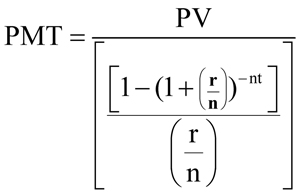
Where,
- PMT = monthly loan payment
- PV = present value of the loan or the principal amount
- r = periodic interest rate or annual interest rate
- t = length of time (usually in years) to repay the loan
- n = number of compounding periods in the year.
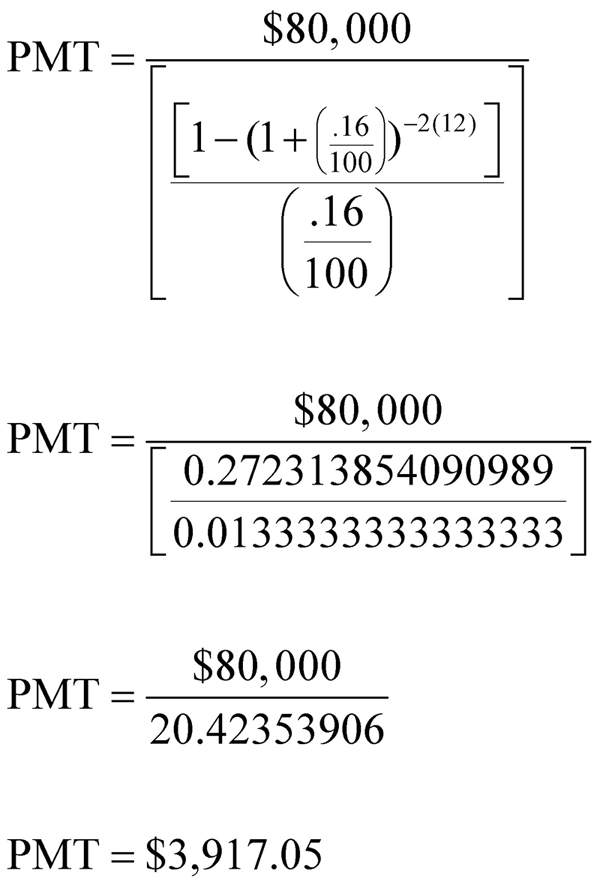
A math equation in conjunction with Microsoft Excel was used to construct the repayment ledger for the 2-year home loans as presented in the second table immediately below. An online home loan calculator such as Investopedia's online calculator would have been sufficient to complete the calculation. Using an online calculator definitely would have been much quicker at producing the same results as detailed in the next two tables below.
After using the math equation, the table shows that your monthly payment would be $3,917.05 to pay off a loan for $80,000 in 2 years at a 16% interest rate compounded monthly. To manually determine how the $3,917.05 monthly payment would be amortized between principal and interest, you would need to determine the monthly interest rate. Divide 16% by 12 months and it yields a monthly interest rate of 1.33333333333333%. Next, multiply the monthly interest rate (1.33333333333333%) times the $80,000 balance to determine how much of the first payment should be allocated to interest and how much of it should be allocated to principal. The multiplication reveals that $1,066.67 of the first payment should be applied to interest. Therefore, the remainder of $2,850.38 should be applied to principal for a total payment of $3,917.05 (that is, $1,066.67 + $2,850.38). To determine how much of the second payment should be applied to interest, then multiply the monthly interest rate by the forwarding balance. (See the first table immediately below.)
The first table immediately below shows how, manually using an adding machine or hand-held calculator, the first 4 (of 24) monthly payments on the $80,000 home loan were amortized between principal and interest payments. The second table below shows how, using the math equation in conjunction with Microsoft Excel, the complete 2-year home loan repayment ledger or amortization schedule should look covering the duration of the example 2-year home loan. The second table below reveals that, over the course of the 2-year period for this example $80,000 home loan, you will have paid a total of $14,009.17 in interest.
Compound Interest and 2-Year Home: Manually Constructing the Repayment Ledger Year 1, Month 1 Year 1, Month 2 Year 1, Month 3 Year 1, Month 4 1st Payment 2nd Payment 2nd Payment 2nd Payment Principal Balance $80,000.00 $77,149.62 $74,261.23 $71,334.33 Monthly Interest Rate 0.013333 0.013333 0.013333 0.013333 Monthly Interest Amount = $1,066.67 $1,028.66 $990.15 $951.12 Total Monthly Payment $3,917.05 $3,917.05 $3,917.05 $3,917.05 Less Monthly Interest Paid $1,066.67 $1,028.66 $990.15 $951.12 Monthly Principal Paid = $2,850.38 $2,888.39 $2,926.90 $2,965.92 Principal Balance $80,000.00 $77,149.62 $74,261.23 $71,334.33 Less Monthly Principal $2,850.38 $2,888.39 $2,926.90 $2,965.92 Adjusted Principal Balance = $77,149.62 $74,261.23 $71,334.33 $68,368.41 Total Monthly Payment $3,917.05 $3,917.05 $3,917.05 $3,917.05
Compound Interest and 2-Year Home Loan: Automating the Repayment Ledger Payment Number Month Beginning Principal Balance Principal Paid Interest Paid Total Paid Ending Principal Balance Cumulative Principal Paid Cumulative Interest Paid Cumulative Total Paid 1 Jan-1-2026 $80,000.00 $2,850.38 $1,066.67 $3,917.05 $77,149.62 2,850.38 1,066.67 3,917.05 2 Feb-1-2026 $77,149.62 $2,888.39 $1,028.66 $3,917.05 $74,261.23 5,738.77 2,095.33 7,834.10 3 Mar-1-2026 $74,261.23 $2,926.90 $990.15 $3,917.05 $71,334.33 8,665.67 3,085.48 11,751.15 4 Apr-1-2026 $71,334.33 $2,965.92 $951.12 $3,917.05 $68,368.41 11,631.59 4,036.60 15,668.20 5 May-1-2026 $68,368.41 $3,005.47 $911.58 $3,917.05 $65,362.94 14,637.06 4,948.18 19,585.24 6 Jun-1-2026 $65,362.94 $3,045.54 $871.51 $3,917.05 $62,317.39 17,682.61 5,819.69 23,502.29 7 Jul-1-2026 $62,317.39 $3,086.15 $830.90 $3,917.05 $59,231.24 20,768.76 6,650.59 27,419.34 8 Aug-1-2026 $59,231.24 $3,127.30 $789.75 $3,917.05 $56,103.94 23,896.06 7,440.34 31,336.39 9 Sep-1-2026 $56,103.94 $3,169.00 $748.05 $3,917.05 $52,934.95 27,065.05 8,188.39 35,253.44 10 Oct-1-2026 $52,934.95 $3,211.25 $705.80 $3,917.05 $49,723.70 30,276.30 8,894.19 39,170.49 11 Nov-1-2026 $49,723.70 $3,254.07 $662.98 $3,917.05 $46,469.63 33,530.37 9,557.17 43,087.54 12 Dec-1-2026 $46,469.63 $3,297.45 $619.60 $3,917.05 $43,172.18 36,827.82 10,176.77 47,004.59 13 Jan-1-2027 $43,172.18 $3,341.42 $575.63 $3,917.05 $39,830.76 40,169.24 10,752.39 50,921.63 14 Feb-1-2027 $39,830.76 $3,385.97 $531.08 $3,917.05 $36,444.79 43,555.21 11,283.47 54,838.68 15 Mar-1-2027 $36,444.79 $3,431.12 $485.93 $3,917.05 $33,013.67 46,986.33 11,769.40 58,755.73 16 Apr-1-2027 $33,013.67 $3,476.87 $440.18 $3,917.05 $29,536.80 50,463.20 12,209.58 62,672.78 17 May-1-2027 $29,536.80 $3,523.22 $393.82 $3,917.05 $26,013.58 53,986.42 12,603.41 66,589.83 18 Jun-1-2027 $26,013.58 $3,570.20 $346.85 $3,917.05 $22,443.38 57,556.62 12,950.26 70,506.88 19 Jul-1-2027 $22,443.38 $3,617.80 $299.25 $3,917.05 $18,825.57 61,174.43 13,249.50 74,423.93 20 Aug-1-2027 $18,825.57 $3,666.04 $251.01 $3,917.05 $15,159.53 64,840.47 13,500.51 78,340.98 21 Sep-1-2027 $15,159.53 $3,714.92 $202.13 $3,917.05 $11,444.61 68,555.39 13,702.64 82,258.03 22 Oct-1-2027 $11,444.61 $3,764.45 $152.59 $3,917.05 $7,680.16 72,319.84 13,855.23 86,175.07 23 Nov-1-2027 $7,680.16 $3,814.65 $102.40 $3,917.05 $3,865.51 76,134.49 13,957.63 90,092.12 24 Dec-1-2027 $3,865.51 $3,865.51 $51.54 $3,917.05 $0.00 80,000.00 14,009.17 94,009.17 TOTAL $80,000.00 $14,009.17 $94,009.17
Instead of utilizing the math equation, an online calculator, or manually using an adding machine or hand-held calculator, one alternative way to compute the principal part of the first monthly payment on the home loan would be to use an electronic spreadsheet such as Microsoft Excel's CUMPRINC financial function [CUMPRINC(rate,nper,pv,start_period,end_period,type); therefore, CUMPRINC(0.16 ÷ 12,2 × 12,80000,1,24,0) = $2,850.38]. To compute the interest due on the first monthly payment on the home loan, you could use Microsoft Excel's CUMIPMT financial function [CUMIPMT(rate,nper,pv,start_period,end_period,type); therefore, CUMIPMT(0.16 ÷ 12,2 × 12,80000,1,1,0) = $1,066.67]. To compute the interest rate on the home loan, you could use Microsoft Excel's RATE financial function [RATE(nper,pmt,pv,fv,type,guess): therefore, RATE(2 × 12, -3917.08447118596, 80000) × 12 = 16%].
Another alternative way to complete these calculations is to utilize the artificial intelligence (AI) machines or chatbots to obtain the answers. The following three AI machines are very good at completing financial calculations such as the ones discussed on this 2027 winner page:
For instance, you could utilize the above three AI machines to answer questions such as the following questions discussed on this 2027 winner page:
- What is the monthly payment amount on an $80,000, two-year home loan with a rate of 16% compounded monthly?
- What is the total interest paid on an $80,000, two-year home loan with a rate of 16% compounded monthly?
- What is the interest rate on a $200, 14-day payday loan with interest of $35?
- How much must I save per month to have $80,000 in 5 years at 5% interest compounded monthly?
An added bonus of using the above three AI machines besides their accuracy is that they permit anyone to use them as a guest user without, first, having to create an account. The only drawback to using the AI machines, in general, is the fact that they are intensive in their use of resources simply to answer a single query (namely, the resources of electricity and water that are used on the backend at the data centers). CAVEAT: Proceed with care when using the various AI machines (namely, chatbots) in the marketplace. They do not always give accurate or consistent answers. The AI machines, generally speaking but namely chatbots, remain a work in progress as of 2026. For, as of 2026, chatbots are known to make mistakes or hallucinate.
In reality, most USA home loans are established with a 30-year (or 360-month) repayment period to make home ownership more affordable to the borrower. For instance, if the $80,000 home loan would have been amortized over a 30-year period, then the monthly payments would have been $1,075.81 to pay off the loan in 30 years at a 16% interest rate compounded monthly.
For those households who prefer not to obtain a home loan simply to avoid paying the interest, there is another option. The household can pay for the home outright with cash. Since most households do not have the cash on hand to pay for a home outright, first, they would need to save the cash. By selecting the ordinary annuity option, an online calculator could be used to establish an appropriate savings plan to secure the cash needed to purchase the home on a fully paid basis upfront.
For instance, to save $80,000 in 5 years using a 5% interest rate, the household would need to deposit $1,176.37 monthly into an ordinary annuity account at the beginning of each month for 5 consecutive years. In this example, the household would have to wait for 5 years to purchase the home instead of the 2 years that it would have taken for the household to purchase the home if the household had been willing to borrow the money and pay the $14,009.17 in interest (assuming a 16% borrowing interest rate). The pay-in-cash assumption here is that a similar home would still be available for the household to purchase in the amount of $80,000 after the 5 years have passed. It is possible that the same or a similar home will have appreciated in value to, say, for example, $120,000, after 5 years have passed. Inflation, too, is likely to have risen during the intervening 5 years of savings. So, after 5 years have passed, most likely, the $80,000 saved would not be enough money to purchase a similar house with cash, say, within the same city.
The math equation used to determine the monthly deposits required to obtain $80,000 to purchase, say, a home, in cash is referred to as the sinking fund payment or future value for an ordinary annuity. In the case of the example 2-year home loan, with the assistance of Microsoft Excel, the required monthly deposits of $1,176.37 (at 5% interest compounded monthly) would be determined like this:
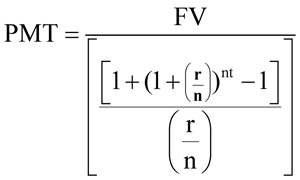
Where,
- PMT = periodic deposit required (in this example, monthly deposits)
- FV = future value or future amount desired
- r = periodic interest rate or annual interest rate
- n = number of compounding periods or compounding frequency
- t = time or numbers of years deposits are required (in this example, monthly deposits)
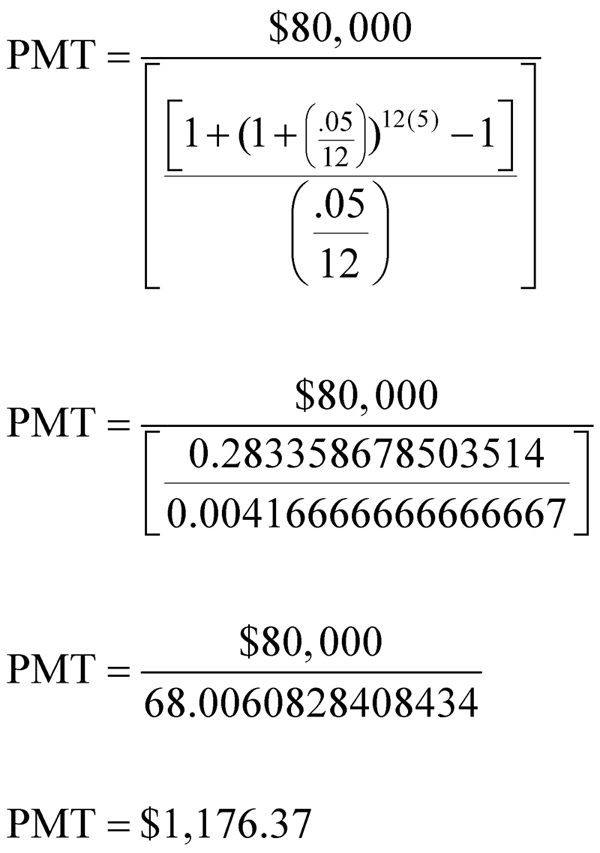
More About Add-on Interest from the Perspective of Borrowing:
When purchasing merchandise on credit at smaller business establishments, some of these small-business merchants offer closed-end borrowing. With closed-end borrowing, often you are not given a credit card. Instead, you sign a contract with the business establishment to repay the loan using the add-on interest method. You are expected to repay the loan in accordance with a repayment schedule that is established in the underlying contract. You are not expected to add new charges to the loan. The account is closed when the balance becomes $0.
The chief difference between compound-interest borrowing and add-on borrowing is this: On the one hand, amortized compound-interest borrowing only charges interest based on the balance due. As the balance decreases with amortized borrowing, the total interest required also decreases. On the other hand, add-on borrowing charges interest on the initial balance and the interest payments remain constant over the life of the loan. As the balance decreases with add-on borrowing, the total interest required does not decrease.
Assume, for instance, you recently entered college. You determine that it would be so much easier for you to complete your required homework assignments if you owned a super fast, high-end laptop computer. You determine that it will cost about $1,250 USD to purchase the laptop computer. You do not have the required $1,250, but you need the laptop computer as soon as possible to complete your homework assignments.
Your solution would be to go to the neighborhood computer store and enter an installment-loan agreement with the store's owner. The owner of the computer store would check your credit rating. Afterwards, the owner of the computer store might tell you that you are eligible to take home the $1,250 laptop on credit. The owner informs you that you'll be charged an interest rate of 21% per month with a repayment period of 2 years (or 24 months).
Based on this information, the store owner proceeds to create a repayment ledger. Your balance due on the laptop is $1,775 (that is, $1,250 plus the $525 in interest). Because the payments are due monthly, you would divide $1,775 by the 24 months to obtain the monthly payments of $73.958. Similarly, you would divide $525 by 24 months to determine that $21.875 of the monthly payment would consist of interest owed. Naturally, the computer store owner would round up the monthly principal payment to $73.96 and the monthly interest payment to $21.88.
The table below provides a detailed view of how the store owner's repayment ledger would look when the add-on interest method is applied to the laptop loan purchase.
Add-on Interest Example for the Laptop Loan Payment Schedule Year Month Count Month Principal Balance Forwarded +
Monthly Interest Added to Balance=
Gross Balance-
Less Monthly Payment=
New Principal Balance DuePrincipal Part of Monthly Payments Year 1 1 Jan $1,250.000 $21.875 $1,271.875 -$73.958 $1,197.92 -$52.08 Year 1 2 Feb $1,197.917 $21.875 $1,219.792 -$73.958 $1,145.83 -$52.08 Year 1 3 Mar $1,145.833 $21.875 $1,167.708 -$73.958 $1,093.75 -$52.08 Year 1 4 Apr $1,093.750 $21.875 $1,115.625 -$73.958 $1,041.67 -$52.08 Year 1 5 May $1,041.667 $21.875 $1,063.542 -$73.958 $989.58 -$52.08 Year 1 6 Jun $989.583 $21.875 $1,011.458 -$73.958 $937.50 -$52.08 Year 1 7 Jul $937.500 $21.875 $959.375 -$73.958 $885.42 -$52.08 Year 1 8 Aug $885.417 $21.875 $907.292 -$73.958 $833.33 -$52.08 Year 1 9 Sep $833.333 $21.875 $855.208 -$73.958 $781.25 -$52.08 Year 1 10 Oct $781.250 $21.875 $803.125 -$73.958 $729.17 -$52.08 Year 1 11 Nov $729.167 $21.875 $751.042 -$73.958 $677.08 -$52.08 Year 1 12 Dec $677.083 $21.875 $698.958 -$73.958 $625.00 -$52.08 Year 2 13 Jan $625.000 $21.875 $646.875 -$73.958 $572.92 -$52.08 Year 2 14 Feb $572.917 $21.875 $594.792 -$73.958 $520.83 -$52.08 Year 2 15 Mar $520.833 $21.875 $542.708 -$73.958 $468.75 -$52.08 Year 2 16 Apr $468.750 $21.875 $490.625 -$73.958 $416.67 -$52.08 Year 2 17 May $416.667 $21.875 $438.542 -$73.958 $364.58 -$52.08 Year 2 18 Jun $364.583 $21.875 $386.458 -$73.958 $312.50 -$52.08 Year 2 19 Jul $312.500 $21.875 $334.375 -$73.958 $260.42 -$52.08 Year 2 20 Aug $260.417 $21.875 $282.292 -$73.958 $208.33 -$52.08 Year 2 21 Sep $208.333 $21.875 $230.208 -$73.958 $156.25 -$52.08 Year 2 22 Oct $156.250 $21.875 $178.125 -$73.958 $104.17 -$52.08 Year 2 23 Nov $104.167 $21.875 $126.042 -$73.958 $52.08 -$52.08 Year 2 24 Dec $52.083 $21.875 $73.958 -$73.958 $0.00 -$52.08 TOTAL $525.00 -$1,775.00 -$1,250.00
Conclusions:
The precursor to Microsoft Excel was the software application titled Lotus 1-2-3. The 1 in Lotus 1-2-3 stood for its spreadsheet capabilities; the 2 stood for its charting capabilities; and the 3 stood for its database capabilities. Microsoft proceeded to perfect the electronic spreadsheet while maintaining Lotus 1-2-3's legacy spreadsheet, charting, and database capabilities—and more. To be sure, as is the case with the shrink-wrapped versions of the Microsoft Office Professional Productivity Suite—with its companion macro engine—Microsoft Office is a very powerful piece of software for getting things done efficiently and professionally as evidenced by a tiny sliver of Excel's capabilities used in conjunction with this page's discussion of the Trump Accounts program.
Although today's professional office-suite products have expanded to offer a multitude of capabilities and components as of 2026, the core components of office-suite products normally would contain an electronic spreadsheet application (à la Microsoft Excel), a word processing application (à la Microsoft Word), a presentation application (à la Microsoft PowerPoint), a database application (à la Microsoft Access), and perhaps even an email application (à la Microsoft Outlook). For example, not only did the 2003 professional version of Microsoft Office include Word, Excel, PowerPoint, Access, and Outlook but also other applications were available such as Publisher, Project, Visio, FrontPage, OneNote, InfoPath, Money, Picture It!, Encarta, MapPoint, and Visual Studio. Microsoft does have many competitors in the office-suite product space. Microsoft's office-suite competitors include the following ones:
- Google Workspace
- Apple iWork
- LibreOffice
- OpenOffice
- Collabora Online
- WordPerfect Office
- WPS Office
- Calligra Suite
- Zoho Office Suite
- Thinkfree Office
- ONLYOFFICE
- SoftMaker Office
- MobiOffice
- Ability Office
- Hancom Office
- ExtendOffice
- StarOffice Legacy Version
- IBM Planning Analytics
It should be noted that except those software applications pre-installed on new computers and laptops, as of 2026, in many instances, the online subscription/cloud-based model of accessing software applications have begun to replace the shrink-wrapped model or software-in-a-box model that is purchased from a retailer. Particularly, proprietary (copyrighted) software applications have begun adhering to the subscription model as compared to open-source software applications that are downloadable from the software maker's website.
This 2027 winner page is primarily about numbers. Particularly, this 2027 winner page is about numbers as they relate to the Trump Accounts program. To conclude this 2027 winner page, here are several entertaining videos about numbers for you to view if you care to do so.
Watch [Danny Kaye - Pythagorean Theorem (Merry Andrew 1958)]
Watch (Pythagorean Theorem | MathHelp.com)
Watch (Converse of Pythagorean Theorem | MathHelp.com)
Watch (Pythagorean Theorem in Real Life Applications)
For more about mathematics, visit this link: Math is Fun
Speaking of fun, in closing this 2027 winner page and to take a break away from the numbers, check out this "irresistible" bit of big fun:
Watch (Wisin & Yandel, Irresistible)
Watch [Madcon, Beggin' (Street Dance 3D - Dance Mix)]
Also, in closing and to take a break away from the numbers, check out this bit of blossoming reciprocal romantic love:
Watch (Barry White, Can't Get Enough Of Your Love, Babe)
Or, as John Wilbye would say it:
Love Not Me For Comely Grace
Love not me for comely grace, For my pleasing eye or face, Nor for any outward part, No, nor for a constant heart: For these may fail or turn to ill, So thou and I shall sever: Keep, therefore, a true woman’s eye, And love me still but know not why— So hast thou the same reason still To doat upon me ever!
By John Wilbye—born 1574 () and died 1638 () at 64 years old
(Audio Reading Courtesy of LibriVox: John Wilbye, Love not me for comely grace)
Watch (Musiq Soulchild, sobeautiful)
Watch [Phyllisia Ross - So Beautiful (Musiq Soulchild Cover)]
This final video below represents a nod to Microsoft—and its Microsoft Flight Simulator product offering. Courtesy of its founders Bill Gates and Paul Allen, Microsoft has continued to crank out great software products over the intervening years since its 1975 inception ()—albeit the free and open-source software movement continues to make steady headway in the software application space since its 1985 inception (). I suppose Microsoft Corporation would say, "the sky's the limit," which is another way of saying "there is no limit" when it comes to its future prospects. Whereas cloud computing was the buzzword of the computer industry during the 2010's, as of 2026, artificial intelligence (AI) seems to be the thing that has the computer industry enthralled during the 2020's—including Microsoft Corporation.
Note: Please click the "Credits" link below to view the resources used to create this 2027 Winner page.