The webpage for the 2026 award winner placed the spotlight on the Universal Declaration of Humans Rights. This 2026 bonus page places the spotlight on the Convention on the Rights of the Child. In conjunction with the Convention on the Rights of the Child, this 2026 bonus page honors two non-profit organizations: (1) Humanium and (2) the Child Rights International Network (CRIN). Humanium and CRIN are being honored on this bonus page because they are playing leading and influential roles in their tireless efforts to promote the rights and causes of children all over the world. Honorable mention goes to the Save the Children, SOS Children's Villages, and the voicesofyouth.org (VOY) organizations. For, like adults, children have rights, too.
Humanium and CRIN are augmenting the ongoing work of international bodies such as:
the United Nations International Children's Emergency Fund (UNICEF), which has been active since 11-December-1946 (or ) but UNICEF is now officially known as the United Nations Children's Fund since 07-July-1953 (or )
the United Nations Convention on the Rights of the Child (since 20-November-1989 or ) and commonly abbreviated as the CRC or UNCRC
the United Nations' Office of the High Commissioner for Human Rights (since 20-December-1993 (or ) and commonly abbreviated as OHCHR
Humanium and CRIN are motivated by a genuine desire to advance the prosperity, vitality, and happiness of the world's children. The beneficial interests of the world's children are the uppermost concerns for Humanium and CRIN.
Children ought to be able to live healthy, happy, vivacious, and productive lives regardless of the countries where they reside. Children ought to be able to develop to their fullest potentials, abilities, or talents regardless of the countries where they reside. At present as of 2026, too much human potential is being wasted, lost, or foregone due to too many children being idle, unproductive, and underdeveloped. Humanium and CRIN are striving to create societal structures or conditions that are conducive to positive childhood outcomes.
According to the United Nations' (UN) organizational chart, the Office of the High Commissioner for Human Right (OHCHR), which was established on 20-December-1993 (or ), falls under the direction of the UN's Secretariat. The Convention on the Rights of the Child falls under the auspices of the OHCHR. The United Nations' other body exclusively affiliated with the growth and development of children is the United Nations International Children's Emergency Fund (UNICEF), and UNICEF also is referred to as the Children's Fund. UNICEF falls under the direction of the UN's General Assembly according to the UN's organizational chart.
As is the case with the Universal Declaration of Human Rights, in this particular instance, the mission of OHCHR and UNICEF is to find new and innovative ways to "bridge the gap" between children rights in theory (on paper) and children rights in practice (in reality on the ground). Their mission is to keep countries from backsliding on their commitments to making children rights a reality for all of the world's children. Humanium and CRIN, in turn, are playing vital roles in this ongoing global children-rights endeavor.
Holistic Approach to Child Growth and Development
While speaking about the rights of the child, the biological, physiological, and psychological processes and changes that children experience should be taken into consideration as children make the childhood-to-adulthood transition in life. A holistic view of child growth and development is of utmost importance and urgency. A holistic view is required to help ensure that children make a successful childhood-to-adulthood transition without any lingering damage being done to them throughout the process.
Vaccines are not readily available for children to take in all countries. Despite a barrage of misinformation and disinformation against vaccines, the evidence is clear and overwhelming: Vaccines are safe, and vaccinations are effective. Getting vaccinated prevents diseases. Getting vaccinated saves lives. Trust the science and not all of the negative, anti-vaccine misinformation, disinformation, and conspiracy theories.
Child Growth and Development Theories
Many theories exist about child growth and development and how best to foster it. As explained in the next video, one of the more popular and often-quoted theories of child growth and development to emerge is Erik Erikson's (born 15-June-1902 and died 12-May-1994) theory known as the Stages of Psychosocial Development Theory. Erik Erikson's 8-stage theory is outlined and summarized in the multi-color table below. From a different perspective, the circular graphic below outlines Urie Bronfenbrenner's (born 29-April-1917 and died 25-September-2005) 5-System ecological theory of human development.
To use the butterfly analogy, children, too, must undergo a series of developmental stages before reaching adulthood. The imperative is to make children's journey from childhood to adulthood a successful journey.
Butterfly metamorphosis stages
It Takes a Village to Successfully Raise a Child
As depicted in the two graphics immediately above [Erik Erikson's Stages of Psychosocial Development and Urie Bronfenbrenner’s Ecological Systems Theory] plus the two graphics immediately below [Weld County's Roadmap 4 Kids] and [San Bernardino Countywide Vision], it takes a village to foster the successful growth and development of children. The village entails the support that children receive from parents and family; school system support; government oversight and support; business sector support of schools and education; and the support of community and faith-based organizations.
Roadmap4Kids - resources for children, from prenatal to 8 years of age (Weld County, CO - USA)
The Role of Education
The role of education is a crucially important one for the development of children. The purpose of education, with its usual 12-year minimum of school attendance and completion, is to prepare students to become responsible, productive, self-disciplined, and self-supporting members in contemporary civil society. Another purpose of education is to teach students how to behave civilly by leading principled lives with the utmost respect for self, respect for others, respect for the property of others, respect for the rule of law, and respect for human life regardless of race, color, creed, ethnicity, gender, sexual orientation, religion, disability, national origin, socioeconomic birth status, political opinion, and so forth. To be sure, basic human decency demands that humans learn to treat one another with courtesy and respect, and not to treat one another with violence and hatred.
The questions that each high school senior and college freshman should be asking himself or herself are these: What am I going to do to earn money to make a living after I complete my school studies? What skills or knowledge must I possess to obtain a job in my chosen profession or field of study? The focal point of their high school and college studies should be on obtaining those requisite skills and knowledge needed to sustain a long-term and lifetime work career after they graduate from high school or college.
With few exceptions (such as those children who are fortunate to be endowed with large monetary inheritances), success in life will not be handed to school graduates on a silver platter. School graduates have to go into the broader society [job market] and secure a lawful career niche. A lawful career niche is what it will take to make a good living and to support a family after school graduation. The key to successfully securing a lawful career niche involves studying hard to get a good education or working hard at mastering a specific skill. Education is very important. Students should take school attendance and classroom instructions seriously throughout their 12 or more years of attending school.
Granted, sometimes there is a mismatch between job seekers and job vacancies and, granted, launching a successful business venture is not always an easy thing to do. The mismatch is not a good thing when there are more job seekers than there are job vacancies. The end result is high unemployment and underemployment rates in civil society. Consistently high unemployment rates will tempt some of those who are adversely impacted with long-term joblessness to turn to unlawful or criminal means to earn money. To be fair about unemployment, some members of society do engage in criminal activities purely for profit, and their choice to engage in criminal careers is unrelated to a high unemployment rate.
Regrettably, in many of the world's poorest countries, children have to pay some type of fee to attend school not to mention they also require money to pay for school uniforms, books, supplies, lunch, transportation, field trips, and so forth. Oftentimes, the poorest of the poor do not have the money to pay the school-attendance fee. So, the poorest of the poor usually drop out of school or do not attend school when a fee is required. At the same time, it should be acknowledged that, in some of the poorest countries on Earth, children also drop out of school for various other reasons not related to school fees such as poor academic performance in school; age disparity with others in the classroom setting due to grade retention(s); social problems with classmates or teacher; peer pressure to join other school dropouts; contracting various illnesses and diseases leading to many absentees from school and falling behind on school work and subject-matter tests; pressure from parents to stay home to work (in the case of boys) or to stay home and babysit (in the case of girls); and so on.
The most unfortunate and unsettling part about not attending school is this: For the worst-case scenarios in the poorest countries, some of these idle boys are susceptible to being recruited to become child soldiers; some of these idle girls are susceptible to becoming teen moms from unwanted pregnancies. The menace of drug addiction is always present to adversely impact the life of the school dropout not the mention the other social ills that accompany drug addiction. For a child to not complete a basic 12-year high school academic or vocational education, it represents a huge opportunity loss for that child's growth and development. Education matters.
Passing the Positivity Baton to the Next Generation
Today's children are tomorrow's leaders. The baton passes to their generation. They will be endowed with the awesome responsibility of managing and running this magnificent planet called Earth. Faced with a newly emerging Age of Artificial Intelligence on the horizon, for humanity's sake, it is crucial for today's children to remain focused on the big picture and to make wise decisions. It is crucially important for today's children to take seriously their endowment as Earth's caretakers. It is crucially important for today's children to appreciate and to take good care of their Mother, the Earth, for the benefit of the generations of humans to follow them. Otherwise, Father Time might not be kind to future generations of humans.
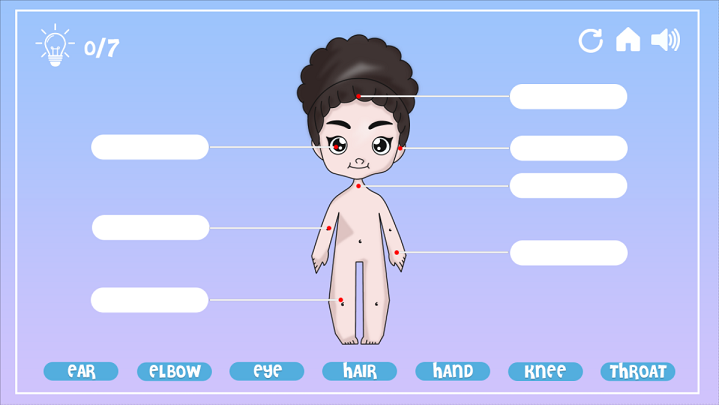
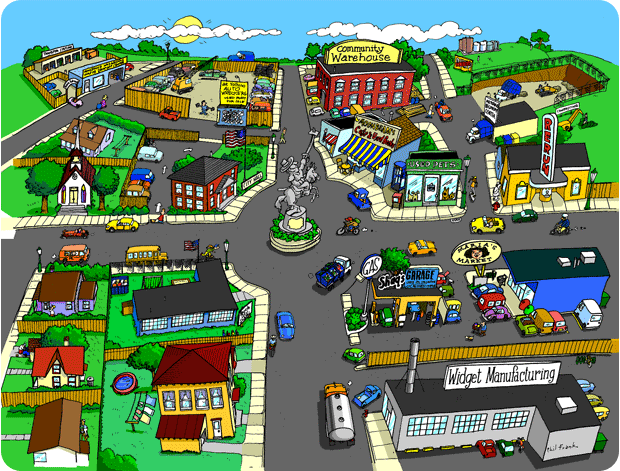
Just for Students: Work (Click Each Image Below to View)
Just for Students: Play (Click Each Image Below to View)
United Nations for Students (Click Each Image Below to View)
The United Nations' Charter was signed on 26-June-1945 (), and the United Nations' Charter took effect on 24-October-1945 (). The United Nations (UN) was established as a direct result of World War II's many, many awful, brutal, and gruesome fatalities along with the immense destruction of property. The United Nations is world renown for its good works in service to humanity. As such, its divisions such as OHCHR and UNICEF stand at the forefront in the quest to improve the human condition including the lives of children.
Since its inception at the close of World War II, the United Nations has been unrelenting in its quest to bring peace, dignity, and prosperity to the peoples of the Earth. This quest has not been an easy one for the United Nations to fulfill given the reality of the United Nations' limited power and limited budget coupled with the constraints placed on it by ongoing superpower and nuclear-nations jostling to exert their influence on UN decision making. The power dynamics between nations often are beyond the auspices of the United Nations.
There have been as many setbacks for the United Nations as there have been accomplishments particularly as it relates to "armed conflicts." Despite these challenges and obstacles, the United Nations has not wavered in its quest to make planet Earth a more hospitable place for all humans to live and enjoy each day. With the passage of time, the United Nations has come to represent the moral conscience of the world.
The United Nations Conference on International Organization (San Francisco, California USA): A Dream of Peace in the Midst of the Burden of War
Granted, much debate is made of the UN's ineffectiveness, ineptitude, and its powerlessness to resolve major international armed conflicts particularly when it comes to armaments and armed conflicts involving the Security Council's 5 permanent members (that is, China, France, Russia, United Kingdom, and United States), involving the geopolitical and strategic interests of the Security Council's 5 permanent members and their allies, and the veto role of the Security Council's 5 permanent members. The United Nations is not the maker and possessor of these stockpiles of armaments; therefore, the United Nations has little control over how these armaments are bought, sold, deployed, and used across the world.
If anything is to be said of the United Nations' effectiveness, there is no denying that the United Nations is a place that's very adept at cataloguing, promulgating, promoting, and standing up for humanity's higher ideals [such as the Universal Declaration of Human Rights, the Convention on the Rights of the Child, etc.] but also the United Nations engages in array of other beneficial endeavors (as outlined in its organizational chart) for which it deserves many commendations. Something else about the United Nations that should be acknowledged is this: The United Nations is very effective at responding to crises (such as humanitarian crises) all over the globe (when given the resources to respond)!
While speaking of the United Nations' original purpose when it was established in 1945, perhaps former United Nations Secretary-General Dag Hammarskjöld put it most succinctly in his press release on 13-May-1954 (). Secretary-General Dag Hammarskjöld reminded the world of the United Nations' primary purpose at the close of his press release: "It has been said that the United Nations was not created in order to bring us to heaven, but in order to save us from hell." In other words, primarily, the United Nations was established to maintain peace on Earth. The United Nations was established to prevent the outbreak of World War III, which possibly could lead to human extinction given the reality of the existence of nuclear and biological weapons. The United Nations initially was established to be the world's peacemaker. The United Nations' chief mission was to ensure that the Doomsday Clock never ticked up to 12:00 midnight, which would mean a World War III type of outcome for humanity as imagined or conjectured in the next video—albeit the Doomsday Clock has since been expanded in scope beyond its nuclear-war inception to also encompass human extinction by other means such as climate change, disruptive technologies, and biosecurity.
The United Nations, initially, was not established to create a Utopian paradise on Earth but rather to foster peace on Earth and goodwill between humans and countries. Granted, as of 2026, the scope and role of the contemporary United Nations has expanded significantly beyond its 1945 beginnings of being the world's peacekeeper. Again, notwithstanding the roles, impacts, and teachings of parents, religion, and education in society, the United Nations has come to be viewed as the world's moral authority. The United Nations stands both as a symbol and a beacon of hope for humanity.
And, in further defense of the United Nations, when armed conflicts do erupt across Earth and when the fighting, killing, and atrocities rage unabated, even the major powers often stand on the sidelines as mere bystanders to these various armed conflicts. For instance, the global community did very little to intervene and end the 2022 armed conflict between the Democratic Republic of the Congo's (DRC) military against the paramilitary Congo River Alliance (AFC)/March 23 Movement (M23). The global community did very little to end the Russian-Ukraine War of 2022. The global community did very little to end the Israel-Gaza war of 2023 or to make significant progress in resolving the Palestinian independence question. The global community did very little to end the Sudan civil war between the Sudanese Armed Forces against the paramilitary Rapid Support Forces. President Donald Trump should be lauded and given credit or high marks for actively seeking to end global armed conflicts rather than standing on the sidelines and watching it all unfold as yet another bystander even if his reason for intervening to end these various conflict is for an ulterior or selfish motive, namely, to win the Nobel Peace Prize.
I apologize, students, for digressing while discussing this topic of "United Nations for Students." I momentarily got sidetracked by delving into and discussing gruesome news about ongoing armed conflicts and the resultant violence and killings in 2025 and also the prospects for World War III and human extinction. The reality is that, when it comes to armed conflicts, sometimes the power aspirations and the geopolitical ambitions of humans can make the world a very dangerous, nasty, turbulent, brutal, torturous, cruel, and fatal place not to mention all of the different types of crimes being committed by humans each day. While discussing this topic of "United Nations for Students," the larger point being made here is this: As conflict erupts between countries, the United Nations is either missing in action or caught in the middle of various armed conflicts as it delicately and diplomatically attempts to navigate these armed conflicts using its moral authority to bring them to a resolution.
Will future generations of humans transform Earth into a Venus-like or Pluto-like planet due to phenomena such as nuclear annihilation, out-of-control climate change, out-of-control artificial intelligence, and so forth [that is, a Hell-like future], or will future generations of humans transform Mars into an Earth-like planet suitable for human colonization en masse [that is, a Heaven-like future]? Will future generations of humans maintain planet Earth as the crown jewel of the Solar System? Time will tell which of these prospective futures shall come to pass.
Convention on the Rights of the Child
The Convention on the Rights of the Child has its genesis with Eglantyne Jebb (born 25-August-1876 and died 17-December-1928). Eglantyne Jebb founded the non-profit organization called Save the Children on 15-April-1919 (). Save the Children was founded as a result of the horrors of World War I (which began on 28-July-1914 and ended on 11-November-1918 or ended ). In 1923, Eglantyne Jebb drafted the Declaration of the Rights of the Child (also known as the Geneva Declaration of the Rights of the Child), and this Declaration, along with subsequent amendments to it in 1948 and 1959, served as the inspiration for the 1989 creation of the Convention on the Rights of the Child. The Save the Children organization remains active, engaged, and stronger than ever as of 2026.
Below is the full text of the Convention on the Rights of the Child in all of its glory along with some children-friendly summary graphics.
The Office of the High Commissioner for Human Rights (OHCHR) was responsible for promulgating the following 54-article document titled Convention on the Rights of the Child as ratified on 20 November 1989 or . The Convention on the Rights of the Child took effect on 2 September 1990 or . Again, the Convention on the Rights of the Child was preceded by the aforementioned Geneva Declaration on the Right of the Child, which was established on 23-February-1923 (or ). The Convention on the Rights of the Child formally, explicitly, and officially established the global principle that children have rights, too.
Convention on the Rights of the Child in 6 Languages:
Adopted and opened for signature, ratification and accession by General Assembly resolution 44/25 of 20 November 1989 (or ) entry into force 2 September 1990 (or ), in accordance with article 49
Preamble
The States Parties to the present Convention,
Considering that, in accordance with the principles proclaimed in the Charter of the United Nations, recognition of the inherent dignity and of the equal and inalienable rights of all members of the human family is the foundation of freedom, justice and peace in the world,
Bearing in mind that the peoples of the United Nations have, in the Charter, reaffirmed their faith in fundamental human rights and in the dignity and worth of the human person, and have determined to promote social progress and better standards of life in larger freedom,
Recognizing that the United Nations has, in the Universal Declaration of Human Rights and in the International Covenants on Human Rights, proclaimed and agreed that everyone is entitled to all the rights and freedoms set forth therein, without distinction of any kind, such as race, colour, sex, language, religion, political or other opinion, national or social origin, property, birth or other status,
Recalling that, in the Universal Declaration of Human Rights, the United Nations has proclaimed that childhood is entitled to special care and assistance,
Convinced that the family, as the fundamental group of society and the natural environment for the growth and well-being of all its members and particularly children, should be afforded the necessary protection and assistance so that it can fully assume its responsibilities within the community,
Recognizing that the child, for the full and harmonious development of his or her personality, should grow up in a family environment, in an atmosphere of happiness, love and understanding,
Considering that the child should be fully prepared to live an individual life in society, and brought up in the spirit of the ideals proclaimed in the Charter of the United Nations, and in particular in the spirit of peace, dignity, tolerance, freedom, equality and solidarity,
Bearing in mind that the need to extend particular care to the child has been stated in the Geneva Declaration of the Rights of the Child of 1924 (or ) and in the Declaration of the Rights of the Child adopted by the General Assembly on 20 November 1959 (or ) and recognized in the Universal Declaration of Human Rights, in the International Covenant on Civil and Political Rights (in particular in articles 23 and 24), in the International Covenant on Economic, Social and Cultural Rights (in particular in article 10) and in the statutes and relevant instruments of specialized agencies and international organizations concerned with the welfare of children,
Bearing in mind that, as indicated in the Declaration of the Rights of the Child, "the child, by reason of his physical and mental immaturity, needs special safeguards and care, including appropriate legal protection, before as well as after birth",
Recalling the provisions of the Declaration on Social and Legal Principles relating to the Protection and Welfare of Children, with Special Reference to Foster Placement and Adoption Nationally and Internationally; the United Nations Standard Minimum Rules for the Administration of Juvenile Justice (The Beijing Rules); and the Declaration on the Protection of Women and Children in Emergency and Armed Conflict, Recognizing that, in all countries in the world, there are children living in exceptionally difficult conditions, and that such children need special consideration,
Taking due account of the importance of the traditions and cultural values of each people for the protection and harmonious development of the child, Recognizing the importance of international co-operation for improving the living conditions of children in every country, in particular in the developing countries,
Have agreed as follows:
PART I OF III
Article 1 - Definition of a child
For the purposes of the present Convention, a child means every human being below the age of eighteen years unless under the law applicable to the child, majority is attained earlier.
Article 2 - No discrimination
States Parties shall respect and ensure the rights set forth in the present Convention to each child within their jurisdiction without discrimination of any kind, irrespective of the child's or his or her parent's or legal guardian's race, colour, sex, language, religion, political or other opinion, national, ethnic or social origin, property, disability, birth or other status.
States Parties shall take all appropriate measures to ensure that the child is protected against all forms of discrimination or punishment on the basis of the status, activities, expressed opinions, or beliefs of the child's parents, legal guardians, or family members.
Article 3 - Best interests of the child
In all actions concerning children, whether undertaken by public or private social welfare institutions, courts of law, administrative authorities or legislative bodies, the best interests of the child shall be a primary consideration.
States Parties undertake to ensure the child such protection and care as is necessary for his or her well-being, taking into account the rights and duties of his or her parents, legal guardians, or other individuals legally responsible for him or her, and, to this end, shall take all appropriate legislative and administrative measures.
States Parties shall ensure that the institutions, services and facilities responsible for the care or protection of children shall conform with the standards established by competent authorities, particularly in the areas of safety, health, in the number and suitability of their staff, as well as competent supervision.
Article 4 - Making rights real
States Parties shall undertake all appropriate legislative, administrative, and other measures for the implementation of the rights recognized in the present Convention. With regard to economic, social and cultural rights, States Parties shall undertake such measures to the maximum extent of their available resources and, where needed, within the framework of international co-operation.
Article 5 - Family guidance as children develop
States Parties shall respect the responsibilities, rights and duties of parents or, where applicable, the members of the extended family or community as provided for by local custom, legal guardians or other persons legally responsible for the child, to provide, in a manner consistent with the evolving capacities of the child, appropriate direction and guidance in the exercise by the child of the rights recognized in the present Convention.
Article 6 - Life, survival and development
States Parties recognize that every child has the inherent right to life.
States Parties shall ensure to the maximum extent possible the survival and development of the child.
Article 7 - Name and nationality
The child shall be registered immediately after birth and shall have the right from birth to a name, the right to acquire a nationality and, as far as possible, the right to know and be cared for by his or her parents.
States Parties shall ensure the implementation of these rights in accordance with their national law and their obligations under the relevant international instruments in this field, in particular where the child would otherwise be stateless.
Article 8 - Identity
States Parties undertake to respect the right of the child to preserve his or her identity, including nationality, name and family relations as recognized by law without unlawful interference.
Where a child is illegally deprived of some or all of the elements of his or her identity, States Parties shall provide appropriate assistance and protection, with a view to re-establishing speedily his or her identity.
Article 9 - Keeping families together
States Parties shall ensure that a child shall not be separated from his or her parents against their will, except when competent authorities subject to judicial review determine, in accordance with applicable law and procedures, that such separation is necessary for the best interests of the child. Such determination may be necessary in a particular case such as one involving abuse or neglect of the child by the parents, or one where the parents are living separately and a decision must be made as to the child's place of residence.
In any proceedings pursuant to paragraph 1 of the present article, all interested parties shall be given an opportunity to participate in the proceedings and make their views known.
States Parties shall respect the right of the child who is separated from one or both parents to maintain personal relations and direct contact with both parents on a regular basis, except if it is contrary to the child's best interests.
Where such separation results from any action initiated by a State Party, such as the detention, imprisonment, exile, deportation or death (including death arising from any cause while the person is in the custody of the State) of one or both parents or of the child, that State Party shall, upon request, provide the parents, the child or, if appropriate, another member of the family with the essential information concerning the whereabouts of the absent member(s) of the family unless the provision of the information would be detrimental to the well-being of the child. States Parties shall further ensure that the submission of such a request shall of itself entail no adverse consequences for the person(s) concerned.
Article 10 - Contact with parents across countries
In accordance with the obligation of States Parties under article 9, paragraph 1, applications by a child or his or her parents to enter or leave a State Party for the purpose of family reunification shall be dealt with by States Parties in a positive, humane and expeditious manner. States Parties shall further ensure that the submission of such a request shall entail no adverse consequences for the applicants and for the members of their family.
A child whose parents reside in different States shall have the right to maintain on a regular basis, save in exceptional circumstances personal relations and direct contacts with both parents. Towards that end and in accordance with the obligation of States Parties under article 9, paragraph 1, States Parties shall respect the right of the child and his or her parents to leave any country, including their own, and to enter their own country. The right to leave any country shall be subject only to such restrictions as are prescribed by law and which are necessary to protect the national security, public order (ordre public), public health or morals or the rights and freedoms of others and are consistent with the other rights recognized in the present Convention.
Article 11 - Protection from kidnapping
States Parties shall take measures to combat the illicit transfer and non-return of children abroad.
To this end, States Parties shall promote the conclusion of bilateral or multilateral agreements or accession to existing agreements.
Article 12 - Respect for children's views
States Parties shall assure to the child who is capable of forming his or her own views the right to express those views freely in all matters affecting the child, the views of the child being given due weight in accordance with the age and maturity of the child.
For this purpose, the child shall in particular be provided the opportunity to be heard in any judicial and administrative proceedings affecting the child, either directly, or through a representative or an appropriate body, in a manner consistent with the procedural rules of national law.
Article 13 - Sharing thoughts freely
The child shall have the right to freedom of expression; this right shall include freedom to seek, receive and impart information and ideas of all kinds, regardless of frontiers, either orally, in writing or in print, in the form of art, or through any other media of the child's choice.
The exercise of this right may be subject to certain restrictions, but these shall only be such as are provided by law and are necessary:
For respect of the rights or reputations of others; or
For the protection of national security or of public order (order public), or of public health or morals.
Article 14 - Freedom of thought and religion
States Parties shall respect the right of the child to freedom of thought, conscience and religion.
States Parties shall respect the rights and duties of the parents and, when applicable, legal guardians, to provide direction to the child in the exercise of his or her right in a manner consistent with the evolving capacities of the child.
Freedom to manifest one's religion or beliefs may be subject only to such limitations as are prescribed by law and are necessary to protect public safety, order, health or morals, or the fundamental rights and freedoms of others.
Article 15 - Setting up or joining groups
States Parties recognize the rights of the child to freedom of association and to freedom of peaceful assembly.
No restrictions may be placed on the exercise of these rights other than those imposed in conformity with the law and which are necessary in a democratic society in the interests of national security or public safety, public order (ordre public), the protection of public health or morals or the protection of the rights and freedoms of others.
Article 16 - Protection of privacy
No child shall be subjected to arbitrary or unlawful interference with his or her privacy, family, home or correspondence, nor to unlawful attacks on his or her honour and reputation.
The child has the right to the protection of the law against such interference or attacks.
Article 17 - Access to information
States Parties recognize the important function performed by the mass media and shall ensure that the child has access to information and material from a diversity of national and international sources, especially those aimed at the promotion of his or her social, spiritual and moral well-being and physical and mental health.
To this end, States Parties shall:
Encourage the mass media to disseminate information and material of social and cultural benefit to the child and in accordance with the spirit of article 29;
Encourage international co-operation in the production, exchange and dissemination of such information and material from a diversity of cultural, national and international sources;
Encourage the production and dissemination of children's books;
Encourage the mass media to have particular regard to the linguistic needs of the child who belongs to a minority group or who is indigenous;
Encourage the development of appropriate guidelines for the protection of the child from information and material injurious to his or her well-being, bearing in mind the provisions of articles 13 and 18.
Article 18 - Responsibility of parents
States Parties shall use their best efforts to ensure recognition of the principle that both parents have common responsibilities for the upbringing and development of the child. Parents or, as the case may be, legal guardians, have the primary responsibility for the upbringing and development of the child. The best interests of the child will be their basic concern.
For the purpose of guaranteeing and promoting the rights set forth in the present Convention, States Parties shall render appropriate assistance to parents and legal guardians in the performance of their child-rearing responsibilities and shall ensure the development of institutions, facilities and services for the care of children.
States Parties shall take all appropriate measures to ensure that children of working parents have the right to benefit from child-care services and facilities for which they are eligible.
Article 19 - Protection from violence
States Parties shall take all appropriate legislative, administrative, social and educational measures to protect the child from all forms of physical or mental violence, injury or abuse, neglect or negligent treatment, maltreatment or exploitation, including sexual abuse, while in the care of parent(s), legal guardian(s) or any other person who has the care of the child.
Such protective measures should, as appropriate, include effective procedures for the establishment of social programmes to provide necessary support for the child and for those who have the care of the child, as well as for other forms of prevention and for identification, reporting, referral, investigation, treatment and follow-up of instances of child maltreatment described heretofore, and, as appropriate, for judicial involvement.
Article 20 - Children without families
A child temporarily or permanently deprived of his or her family environment, or in whose own best interests cannot be allowed to remain in that environment, shall be entitled to special protection and assistance provided by the State.
States Parties shall in accordance with their national laws ensure alternative care for such a child.
Such care could include, inter alia, foster placement, kafalah of Islamic law, adoption or if necessary placement in suitable institutions for the care of children. When considering solutions, due regard shall be paid to the desirability of continuity in a child's upbringing and to the child's ethnic, religious, cultural and linguistic background.
Article 21 - Children who are adopted
States Parties that recognize and/or permit the system of adoption shall ensure that the best interests of the child shall be the paramount consideration and they shall:
Ensure that the adoption of a child is authorized only by competent authorities who determine, in accordance with applicable law and procedures and on the basis of all pertinent and reliable information, that the adoption is permissible in view of the child's status concerning parents, relatives and legal guardians and that, if required, the persons concerned have given their informed consent to the adoption on the basis of such counselling as may be necessary;
Recognize that inter-country adoption may be considered as an alternative means of child's care, if the child cannot be placed in a foster or an adoptive family or cannot in any suitable manner be cared for in the child's country of origin;
Ensure that the child concerned by inter-country adoption enjoys safeguards and standards equivalent to those existing in the case of national adoption;
Take all appropriate measures to ensure that, in inter-country adoption, the placement does not result in improper financial gain for those involved in it;
Promote, where appropriate, the objectives of the present article by concluding bilateral or multilateral arrangements or agreements, and endeavour, within this framework, to ensure that the placement of the child in another country is carried out by competent authorities or organs.
Article 22 - Refugee children
States Parties shall take appropriate measures to ensure that a child who is seeking refugee status or who is considered a refugee in accordance with applicable international or domestic law and procedures shall, whether unaccompanied or accompanied by his or her parents or by any other person, receive appropriate protection and humanitarian assistance in the enjoyment of applicable rights set forth in the present Convention and in other international human rights or humanitarian instruments to which the said States are Parties.
For this purpose, States Parties shall provide, as they consider appropriate, co-operation in any efforts by the United Nations and other competent intergovernmental organizations or non-governmental organizations co-operating with the United Nations to protect and assist such a child and to trace the parents or other members of the family of any refugee child in order to obtain information necessary for reunification with his or her family. In cases where no parents or other members of the family can be found, the child shall be accorded the same protection as any other child permanently or temporarily deprived of his or her family environment for any reason , as set forth in the present Convention.
Article 23 - Children with disabilities
States Parties recognize that a mentally or physically disabled child should enjoy a full and decent life, in conditions which ensure dignity, promote self-reliance and facilitate the child's active participation in the community.
States Parties recognize the right of the disabled child to special care and shall encourage and ensure the extension, subject to available resources, to the eligible child and those responsible for his or her care, of assistance for which application is made and which is appropriate to the child's condition and to the circumstances of the parents or others caring for the child.
Recognizing the special needs of a disabled child, assistance extended in accordance with paragraph 2 of the present article shall be provided free of charge, whenever possible, taking into account the financial resources of the parents or others caring for the child, and shall be designed to ensure that the disabled child has effective access to and receives education, training, health care services, rehabilitation services, preparation for employment and recreation opportunities in a manner conducive to the child's achieving the fullest possible social integration and individual development, including his or her cultural and spiritual development
States Parties shall promote, in the spirit of international cooperation, the exchange of appropriate information in the field of preventive health care and of medical, psychological and functional treatment of disabled children, including dissemination of and access to information concerning methods of rehabilitation, education and vocational services, with the aim of enabling States Parties to improve their capabilities and skills and to widen their experience in these areas. In this regard, particular account shall be taken of the needs of developing countries.
Article 24 - Health, water, food, environment
States Parties recognize the right of the child to the enjoyment of the highest attainable standard of health and to facilities for the treatment of illness and rehabilitation of health. States Parties shall strive to ensure that no child is deprived of his or her right of access to such health care services.
States Parties shall pursue full implementation of this right and, in particular, shall take appropriate measures:
To diminish infant and child mortality;
To ensure the provision of necessary medical assistance and health care to all children with emphasis on the development of primary health care;
To combat disease and malnutrition, including within the framework of primary health care, through, inter alia, the application of readily available technology and through the provision of adequate nutritious foods and clean drinking-water, taking into consideration the dangers and risks of environmental pollution;
To ensure appropriate pre-natal and post-natal health care for mothers;
To ensure that all segments of society, in particular parents and children, are informed, have access to education and are supported in the use of basic knowledge of child health and nutrition, the advantages of breastfeeding, hygiene and environmental sanitation and the prevention of accidents;
To develop preventive health care, guidance for parents and family planning education and services.
States Parties shall take all effective and appropriate measures with a view to abolishing traditional practices prejudicial to the health of children.
States Parties undertake to promote and encourage international co-operation with a view to achieving progressively the full realization of the right recognized in the present article. In this regard, particular account shall be taken of the needs of developing countries.
Article 25 - Review of a child's placement
States Parties recognize the right of a child who has been placed by the competent authorities for the purposes of care, protection or treatment of his or her physical or mental health, to a periodic review of the treatment provided to the child and all other circumstances relevant to his or her placement.
Article 26 - Social and economic help
States Parties shall recognize for every child the right to benefit from social security, including social insurance, and shall take the necessary measures to achieve the full realization of this right in accordance with their national law.
The benefits should, where appropriate, be granted, taking into account the resources and the circumstances of the child and persons having responsibility for the maintenance of the child, as well as any other consideration relevant to an application for benefits made by or on behalf of the child.
Article 27 - Food, clothing, a safe home
States Parties recognize the right of every child to a standard of living adequate for the child's physical, mental, spiritual, moral and social development.
The parent(s) or others responsible for the child have the primary responsibility to secure, within their abilities and financial capacities, the conditions of living necessary for the child's development.
States Parties, in accordance with national conditions and within their means, shall take appropriate measures to assist parents and others responsible for the child to implement this right and shall in case of need provide material assistance and support programmes, particularly with regard to nutrition, clothing and housing.
States Parties shall take all appropriate measures to secure the recovery of maintenance for the child from the parents or other persons having financial responsibility for the child, both within the State Party and from abroad. In particular, where the person having financial responsibility for the child lives in a State different from that of the child, States Parties shall promote the accession to international agreements or the conclusion of such agreements, as well as the making of other appropriate arrangements.
Article 28 - Access to education
States Parties recognize the right of the child to education, and with a view to achieving this right progressively and on the basis of equal opportunity, they shall, in particular:
Make primary education compulsory and available free to all;
Encourage the development of different forms of secondary education, including general and vocational education, make them available and accessible to every child, and take appropriate measures such as the introduction of free education and offering financial assistance in case of need;
Make higher education accessible to all on the basis of capacity by every appropriate means;
Make educational and vocational information and guidance available and accessible to all children;
Take measures to encourage regular attendance at schools and the reduction of drop-out rates.
States Parties shall take all appropriate measures to ensure that school discipline is administered in a manner consistent with the child's human dignity and in conformity with the present Convention.
States Parties shall promote and encourage international cooperation in matters relating to education, in particular with a view to contributing to the elimination of ignorance and illiteracy throughout the world and facilitating access to scientific and technical knowledge and modern teaching methods. In this regard, particular account shall be taken of the needs of developing countries.
Article 29 - Aims of education
States Parties agree that the education of the child shall be directed to:
The development of the child's personality, talents and mental and physical abilities to their fullest potential;
The development of respect for human rights and fundamental freedoms, and for the principles enshrined in the Charter of the United Nations;
The development of respect for the child's parents, his or her own cultural identity, language and values, for the national values of the country in which the child is living, the country from which he or she may originate, and for civilizations different from his or her own;
The preparation of the child for responsible life in a free society, in the spirit of understanding, peace, tolerance, equality of sexes, and friendship among all peoples, ethnic, national and religious groups and persons of indigenous origin;
The development of respect for the natural environment.
No part of the present article or article 28 shall be construed so as to interfere with the liberty of individuals and bodies to establish and direct educational institutions, subject always to the observance of the principle set forth in paragraph 1 of the present article and to the requirements that the education given in such institutions shall conform to such minimum standards as may be laid down by the State.
Article 30 - Minority culture, language and religion
In those States in which ethnic, religious or linguistic minorities or persons of indigenous origin exist, a child belonging to such a minority or who is indigenous shall not be denied the right, in community with other members of his or her group, to enjoy his or her own culture, to profess and practise his or her own religion, or to use his or her own language.
Article 31 - Rest, play, culture, arts
States Parties recognize the right of the child to rest and leisure, to engage in play and recreational activities appropriate to the age of the child and to participate freely in cultural life and the arts.
States Parties shall respect and promote the right of the child to participate fully in cultural and artistic life and shall encourage the provision of appropriate and equal opportunities for cultural, artistic, recreational and leisure activity.
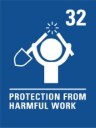
Article 32 - Protection from harmful work
States Parties recognize the right of the child to be protected from economic exploitation and from performing any work that is likely to be hazardous or to interfere with the child's education, or to be harmful to the child's health or physical, mental, spiritual, moral or social development.
States Parties shall take legislative, administrative, social and educational measures to ensure the implementation of the present article. To this end, and having regard to the relevant provisions of other international instruments, States Parties shall in particular:
Provide for a minimum age or minimum ages for admission to employment;
Provide for appropriate regulation of the hours and conditions of employment;
Provide for appropriate penalties or other sanctions to ensure the effective enforcement of the present article.
Article 33 - Protection from harmful drugs
States Parties shall take all appropriate measures, including legislative, administrative, social and educational measures, to protect children from the illicit use of narcotic drugs and psychotropic substances as defined in the relevant international treaties, and to prevent the use of children in the illicit production and trafficking of such substances.
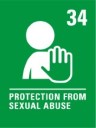
Article 34 - Protection from sexual abuse
States Parties undertake to protect the child from all forms of sexual exploitation and sexual abuse. For these purposes, States Parties shall in particular take all appropriate national, bilateral and multilateral measures to prevent:
The inducement or coercion of a child to engage in any unlawful sexual activity;
The exploitative use of children in prostitution or other unlawful sexual practices;
The exploitative use of children in pornographic performances and materials.
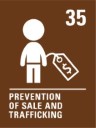
Article 35 - Prevention of sale and trafficking
States Parties shall take all appropriate national, bilateral and multilateral measures to prevent the abduction of, the sale of or traffic in children for any purpose or in any form.
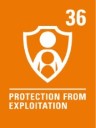
Article 36 - Protection from exploitation
States Parties shall protect the child against all other forms of exploitation prejudicial to any aspects of the child's welfare.
Article 37 - Children in detention
States Parties shall ensure that:
No child shall be subjected to torture or other cruel, inhuman or degrading treatment or punishment. Neither capital punishment nor life imprisonment without possibility of release shall be imposed for offences committed by persons below eighteen years of age;
No child shall be deprived of his or her liberty unlawfully or arbitrarily. The arrest, detention or imprisonment of a child shall be in conformity with the law and shall be used only as a measure of last resort and for the shortest appropriate period of time;
Every child deprived of liberty shall be treated with humanity and respect for the inherent dignity of the human person, and in a manner which takes into account the needs of persons of his or her age. In particular, every child deprived of liberty shall be separated from adults unless it is considered in the child's best interest not to do so and shall have the right to maintain contact with his or her family through correspondence and visits, save in exceptional circumstances;
Every child deprived of his or her liberty shall have the right to prompt access to legal and other appropriate assistance, as well as the right to challenge the legality of the deprivation of his or her liberty before a court or other competent, independent and impartial authority, and to a prompt decision on any such action.
Article 38 - Protection in war
States Parties undertake to respect and to ensure respect for rules of international humanitarian law applicable to them in armed conflicts which are relevant to the child.
States Parties shall take all feasible measures to ensure that persons who have not attained the age of fifteen years do not take a direct part in hostilities.
States Parties shall refrain from recruiting any person who has not attained the age of fifteen years into their armed forces. In recruiting among those persons who have attained the age of fifteen years but who have not attained the age of eighteen years, States Parties shall endeavour to give priority to those who are oldest.
In accordance with their obligations under international humanitarian law to protect the civilian population in armed conflicts, States Parties shall take all feasible measures to ensure protection and care of children who are affected by an armed conflict.
Article 39 - Recovery and reintegration
States Parties shall take all appropriate measures to promote physical and psychological recovery and social reintegration of a child victim of: any form of neglect, exploitation, or abuse; torture or any other form of cruel, inhuman or degrading treatment or punishment; or armed conflicts. Such recovery and reintegration shall take place in an environment which fosters the health, self-respect and dignity of the child.
Article 40 - Children who break the law
States Parties recognize the right of every child alleged as, accused of, or recognized as having infringed the penal law to be treated in a manner consistent with the promotion of the child's sense of dignity and worth, which reinforces the child's respect for the human rights and fundamental freedoms of others and which takes into account the child's age and the desirability of promoting the child's reintegration and the child's assuming a constructive role in society.
To this end, and having regard to the relevant provisions of international instruments, States Parties shall, in particular, ensure that:
No child shall be alleged as, be accused of, or recognized as having infringed the penal law by reason of acts or omissions that were not prohibited by national or international law at the time they were committed;
Every child alleged as or accused of having infringed the penal law has at least the following guarantees:
To be presumed innocent until proven guilty according to law;
To be informed promptly and directly of the charges against him or her, and, if appropriate, through his or her parents or legal guardians, and to have legal or other appropriate assistance in the preparation and presentation of his or her defence;
To have the matter determined without delay by a competent, independent and impartial authority or judicial body in a fair hearing according to law, in the presence of legal or other appropriate assistance and, unless it is considered not to be in the best interest of the child, in particular, taking into account his or her age or situation, his or her parents or legal guardians;
Not to be compelled to give testimony or to confess guilt; to examine or have examined adverse witnesses and to obtain the participation and examination of witnesses on his or her behalf under conditions of equality;
If considered to have infringed the penal law, to have this decision and any measures imposed in consequence thereof reviewed by a higher competent, independent and impartial authority or judicial body according to law;
To have the free assistance of an interpreter if the child cannot understand or speak the language used;
To have his or her privacy fully respected at all stages of the proceedings.
States Parties shall seek to promote the establishment of laws, procedures, authorities and institutions specifically applicable to children alleged as, accused of, or recognized as having infringed the penal law, and, in particular:
The establishment of a minimum age below which children shall be presumed not to have the capacity to infringe the penal law;
Whenever appropriate and desirable, measures for dealing with such children without resorting to judicial proceedings, providing that human rights and legal safeguards are fully respected. 4. A variety of dispositions, such as care, guidance and supervision orders; counselling; probation; foster care; education and vocational training programmes and other alternatives to institutional care shall be available to ensure that children are dealt with in a manner appropriate to their well-being and proportionate both to their circumstances and the offence.
Article 41 - Best law for children applies
Nothing in the present Convention shall affect any provisions which are more conducive to the realization of the rights of the child and which may be contained in:
The law of a State party; or
International law in force for that State.
PART II OF III
Article 42 - Everyone must know children's rights
States Parties undertake to make the principles and provisions of the Convention widely known, by appropriate and active means, to adults and children alike.
Article 43 - How the Convention works
For the purpose of examining the progress made by States Parties in achieving the realization of the obligations undertaken in the present Convention, there shall be established a Committee on the Rights of the Child, which shall carry out the functions hereinafter provided.
The Committee shall consist of eighteen experts of high moral standing and recognized competence in the field covered by this Convention.¹/ The members of the Committee shall be elected by States Parties from among their nationals and shall serve in their personal capacity, consideration being given to equitable geographical distribution, as well as to the principal legal systems.
The members of the Committee shall be elected by secret ballot from a list of persons nominated by States Parties. Each State Party may nominate one person from among its own nationals.
The initial election to the Committee shall be held no later than six months after the date of the entry into force of the present Convention and thereafter every second year. At least four months before the date of each election, the Secretary-General of the United Nations shall address a letter to States Parties inviting them to submit their nominations within two months. The Secretary-General shall subsequently prepare a list in alphabetical order of all persons thus nominated, indicating States Parties which have nominated them, and shall submit it to the States Parties to the present Convention.
The elections shall be held at meetings of States Parties convened by the Secretary-General at United Nations Headquarters. At those meetings, for which two thirds of States Parties shall constitute a quorum, the persons elected to the Committee shall be those who obtain the largest number of votes and an absolute majority of the votes of the representatives of States Parties present and voting.
The members of the Committee shall be elected for a term of four years. They shall be eligible for re-election if renominated. The term of five of the members elected at the first election shall expire at the end of two years; immediately after the first election, the names of these five members shall be chosen by lot by the Chairman of the meeting.
If a member of the Committee dies or resigns or declares that for any other cause he or she can no longer perform the duties of the Committee, the State Party which nominated the member shall appoint another expert from among its nationals to serve for the remainder of the term, subject to the approval of the Committee.
The Committee shall establish its own rules of procedure.
The Committee shall elect its officers for a period of two years.
The meetings of the Committee shall normally be held at United Nations Headquarters or at any other convenient place as determined by the Committee. The Committee shall normally meet annually. The duration of the meetings of the Committee shall be determined, and reviewed, if necessary, by a meeting of the States Parties to the present Convention, subject to the approval of the General Assembly.
The Secretary-General of the United Nations shall provide the necessary staff and facilities for the effective performance of the functions of the Committee under the present Convention.
With the approval of the General Assembly, the members of the Committee established under the present Convention shall receive emoluments from United Nations resources on such terms and conditions as the Assembly may decide.
Article 44 - How the Convention works
States Parties undertake to submit to the Committee, through the Secretary-General of the United Nations, reports on the measures they have adopted which give effect to the rights recognized herein and on the progress made on the enjoyment of those rights
Within two years of the entry into force of the Convention for the State Party concerned;
Thereafter every five years.
Reports made under the present article shall indicate factors and difficulties, if any, affecting the degree of fulfilment of the obligations under the present Convention. Reports shall also contain sufficient information to provide the Committee with a comprehensive understanding of the implementation of the Convention in the country concerned.
A State Party which has submitted a comprehensive initial report to the Committee need not, in its subsequent reports submitted in accordance with paragraph 1 (b) of the present article, repeat basic information previously provided.
The Committee may request from States Parties further information relevant to the implementation of the Convention.
The Committee shall submit to the General Assembly, through the Economic and Social Council, every two years, reports on its activities.
States Parties shall make their reports widely available to the public in their own countries.
Article 45 - How the Convention works
In order to foster the effective implementation of the Convention and to encourage international co-operation in the field covered by the Convention:
The specialized agencies, the United Nations Children's Fund, and other United Nations organs shall be entitled to be represented at the consideration of the implementation of such provisions of the present Convention as fall within the scope of their mandate. The Committee may invite the specialized agencies, the United Nations Children's Fund and other competent bodies as it may consider appropriate to provide expert advice on the implementation of the Convention in areas falling within the scope of their respective mandates. The Committee may invite the specialized agencies, the United Nations Children's Fund, and other United Nations organs to submit reports on the implementation of the Convention in areas falling within the scope of their activities;
The Committee shall transmit, as it may consider appropriate, to the specialized agencies, the United Nations Children's Fund and other competent bodies, any reports from States Parties that contain a request, or indicate a need, for technical advice or assistance, along with the Committee's observations and suggestions, if any, on these requests or indications;
The Committee may recommend to the General Assembly to request the Secretary-General to undertake on its behalf studies on specific issues relating to the rights of the child;
The Committee may make suggestions and general recommendations based on information received pursuant to articles 44 and 45 of the present Convention. Such suggestions and general recommendations shall be transmitted to any State Party concerned and reported to the General Assembly, together with comments, if any, from States Parties.
PART III OF III
Article 46 - How the Convention works
The present Convention shall be open for signature by all States.
Article 47 - How the Convention works
The present Convention is subject to ratification. Instruments of ratification shall be deposited with the Secretary-General of the United Nations.
Article 48 - How the Convention works
The present Convention shall remain open for accession by any State. The instruments of accession shall be deposited with the Secretary-General of the United Nations.
Article 49 - How the Convention works
The present Convention shall enter into force on the thirtieth day following the date of deposit with the Secretary-General of the United Nations of the twentieth instrument of ratification or accession.
For each State ratifying or acceding to the Convention after the deposit of the twentieth instrument of ratification or accession, the Convention shall enter into force on the thirtieth day after the deposit by such State of its instrument of ratification or accession.
Article 50 - How the Convention works
Any State Party may propose an amendment and file it with the Secretary-General of the United Nations. The Secretary-General shall thereupon communicate the proposed amendment to States Parties, with a request that they indicate whether they favour a conference of States Parties for the purpose of considering and voting upon the proposals. In the event that, within four months from the date of such communication, at least one third of the States Parties favour such a conference, the Secretary-General shall convene the conference under the auspices of the United Nations. Any amendment adopted by a majority of States Parties present and voting at the conference shall be submitted to the General Assembly for approval.
An amendment adopted in accordance with paragraph 1 of the present article shall enter into force when it has been approved by the General Assembly of the United Nations and accepted by a two-thirds majority of States Parties.
When an amendment enters into force, it shall be binding on those States Parties which have accepted it, other States Parties still being bound by the provisions of the present Convention and any earlier amendments which they have accepted.
Article 51 - How the Convention works
The Secretary-General of the United Nations shall receive and circulate to all States the text of reservations made by States at the time of ratification or accession.
A reservation incompatible with the object and purpose of the present Convention shall not be permitted.
Reservations may be withdrawn at any time by notification to that effect addressed to the Secretary-General of the United Nations, who shall then inform all States. Such notification shall take effect on the date on which it is received by the Secretary-General
Article 52 - How the Convention works
A State Party may denounce the present Convention by written notification to the Secretary-General of the United Nations. Denunciation becomes effective one year after the date of receipt of the notification by the Secretary-General.
Article 53 - How the Convention works
The Secretary-General of the United Nations is designated as the depositary of the present Convention.
Article 54 - How the Convention works
The original of the present Convention, of which the Arabic, Chinese, English, French, Russian and Spanish texts are equally authentic, shall be deposited with the Secretary-General of the United Nations. In witness thereof the undersigned plenipotentiaries, being duly authorized thereto by their respective Governments, have signed the present Convention.
_________
¹/ The General Assembly, in its resolution 50/155 of 21 December 1995 (or ), approved the amendment to article 43, paragraph 2, of the Convention on the Rights of the Child, replacing the word “ten” with the word “eighteen”. The amendment entered into force on 18 November 2002 (or ) when it had been accepted by a two-thirds majority of the States parties (128 out of 191).
There is simply too much anger and hostility floating around in the global air. So, in closing, do not forget about the Golden Rule: "Do unto others as you would have them do unto you." Also, remember the adage: "Everything [bad or acts of evil] can be justified until it happens to you." Be kind. Do good. Stay Positive. For, there is only one Earth; one atmosphere; and one species—the human species (also known as Homo sapiens sapiens).
Intellectual Property Disclosures: All videos and songs (as well as many of the images) referenced or spotlighted throughout this website are the legal and intellectual properties of others. All content and opinions on this website (bruessard.org) are those of the author (Edward Bruessard) exclusively and do not necessarily reflect the opinions of the contributors, creators, owners, and distributors of these referenced videos, songs, and images. The author holds no legal interest or financial stake in any of these referenced videos, songs, and images. The contributors, creators, owners, and distributors of these referenced videos, songs, and images played no role at all regarding the appearance of said videos, songs, and images throughout this website; they had no clue that this website would be spotlighting their works.
 Annual Bruessard Award
 Read Aloud
-3769268998.png "Free AI Homework Helper, Step-by-step & No Sign-up | StudyX.ai")